

Baker & Baker UK R&D Director, Jonathan Adams discusses redefining “healthy”, embracing tech, and keeping flavour at the heart of bakery innovation
In today’s evolving food landscape, how is the concept of “healthy” being redefined in bakery – and how should companies navigate the tension between processing, nutrition, and public perception?
“Healthy” used to mean low-fat or reduced sugar. Now? It’s a moving target. Consumers want less sugar, salt, and fat – but they are also interested in fewer “processed” ingredients, and increased fibre or protein claims.
That’s tricky, because the ingredients that help manufacturers reduce products that are high in fat, salt and sugar (such as fibres, starches or sweeteners) often fall into the recently-defined ‘ultra-processed’ category.
Many of the large retailers across Europe are striving to improve the perceived healthiness of their product portfolios, whilst not wanting to compromise on taste or quality.
Although the UK market appears to be leading the way in terms of legislation and regulatory action to address sales of certain food groups, the EU and individual European nation states are not too far behind, particularly the marketing of products. But we should expect further action in the years to come, and manufacturers need to understand the potential impacts on how this may affect the formulation of products.
As a sweet bakery manufacturer, we’re constantly working with our supplier base and innovation team to source ingredients that are balancing what’s nutritionally better with what feels “clean” to the consumer. It’s not always black and white, and we have to ensure these new ingredients are as equally functional as they are consumer friendly and affordable.
With growing consumer confusion about ingredients and health messaging – particularly on social media – what role can ‘stealth health’ play, and where should the line be drawn on transparency?
Social media is littered with mis-information concerning ingredients and the perceived impacts of particular food groups, the most recent being the rise in industry and consumer discussions around ‘Ultra Processed Foods’ (UPFs).
There is a clear gap of credible, scientific information on the potential impact of UPFs, particularly if consumed as part of a balanced diet. Although it is important for consumers to be fully aware of what they are eating, much more research is needed to understand whether UPFs truly pose a long-term health risk.
As a responsible food manufacturer, we are always looking at how we can improve the nutritional content of our products. Most of the time, this is done via the concept of ‘stealth health’. For example, last year we replaced over 1,000 tons of sugar with gluco syrups and fibres, and most consumers don’t realise the minimal recipe changes as there is no impact to quality or taste.
All of our products adhere to strict UK and EU regulations, so the level of transparency in terms of ingredients and nutritional information has never been higher.
What does genuine sustainability look like for the bakery sector in 2025, and how can businesses meaningfully measure progress beyond surface-level commitments?
Real sustainability isn’t just about swapping plastic for paper or planting a few trees. It’s about looking at the full lifecycle of a product – how ingredients are created, how products are made, how much energy and in what form it is used, and how much waste we create.
It’s critical for manufacturers to have a clear ESG strategy with commitments that dovetail with the key elements of that strategy. And for business to deliver on those commitments, and be transparent regarding their progress.
Although it’s challenging to address the entire ESG landscape at once, businesses need to focus on initiatives and topics where they can have genuine impact.
For example, we’re working with suppliers on innovative sustainable ingredients, using a number of developments, such as regenerative farming or cocoa alternatives. We recently launched our ChoViva range of products in Germany, which is made using the world’s first cocoa-free chocolate alternative with ground sunflower seeds.
We are looking at a number of decarbonisation initiatives running across our factories, and we’re constantly looking for ways to reduce waste in our bakeries. We have targets in place and we are able to monitor progress in real time.
When it comes to packaging, how can bakeries balance the need for food safety and shelf life with the demand for reduced environmental impact?
Balancing all of the requirements for food safety, shelf life, visibility and functionality whist also minimising packaging can be tricky.
The key is to understand our products and capabilities, customer requirements on packaging, formats and materials, and to develop solutions that best fit the requirements. We have been successful in recent years in reducing the weight or volume of packaging, and shifting to sustainable alternatives where feasible.
Food waste is an important contributor to our emissions, and so we look to optimise shelf life while minimising packaging, reducing gauge, using mono material and ensuring that not only our packaging is recyclable but that it is clearly labelled as such, allowing consumers to dispose of it responsibly.
How is technology – particularly AI and automation – reshaping how new bakery products are developed, and what implications does this have for creativity and ethics in innovation?
AI definitely has a role to play within bakery, and its real world applications are improving at a rapid rate.
Currently we can utilise AI to help create highly realistic visual concepts, which can reduce the need for multiple bakes and submissions. We can run large data models to quickly identify gaps and trends, and it can help enhance ideation and validate thoughts and concepts. However, there is always an important human element in the use of AI, to ensure accuracy and reduce risk, as well as to allow the infusion of human creativity.
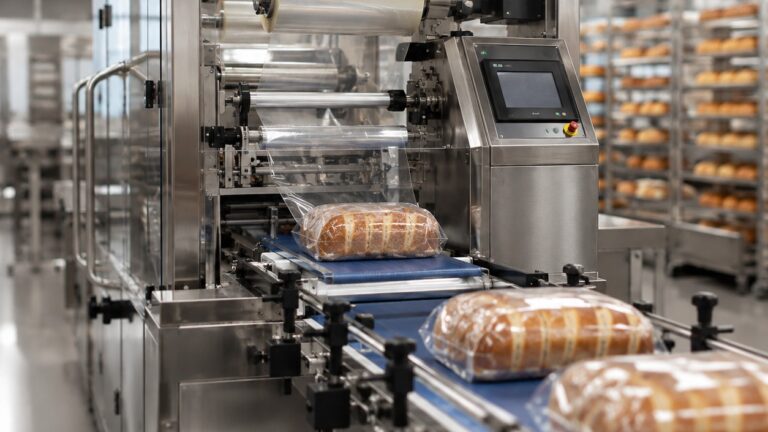
In the near future, we can already see AI supporting with factory automation, creating more efficient manufacturing practices. We have seen programmes that enable bakers to virtually run recipes through factories, reducing trial times and giving accurate results and confidence of success.
There are also compelling reasons to use AI in data collection and analysis, particularly within the ESG space.
We are just starting our AI journey, but we do need to ensure that we don’t lose the human element of development, or create a closed loop of innovation.
Read the full interview in our latest issue here