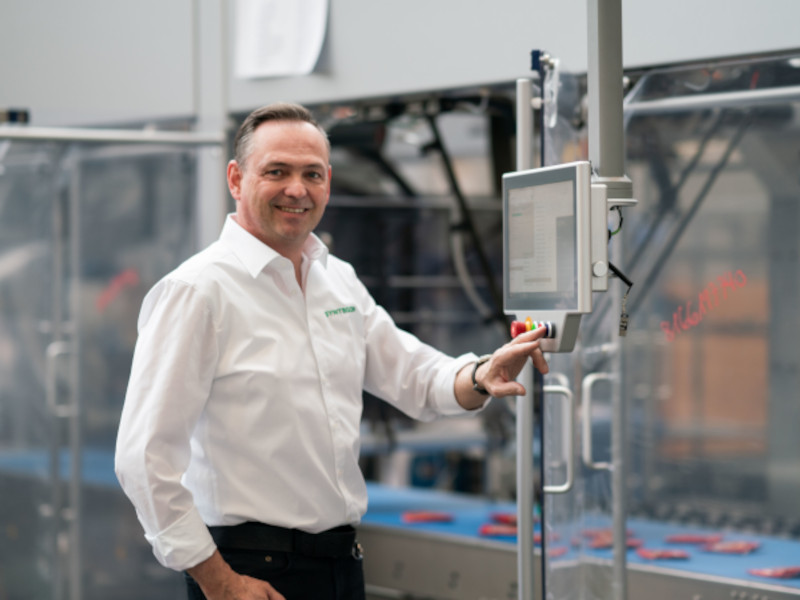

Andreas Schildknecht, global product manager at Syntegon, explains how intelligent automation, connectivity and data-driven decision-making are shaping the Factory of the Future – and why food manufacturers must rethink production now to stay competitive, resilient and sustainable in the face of mounting industry pressures
A shortage of skilled workers, rising costs, margins under pressure and growing sustainability requirements have long become a reality for food producers. Companies must rethink their processes and become smarter, more connected and more adaptable than ever before in order to withstand these changes in the future and to stay competitive. This glimpse into the future of production shows what the path to the “Factory of the Future” might look like.
Machines that communicate with each other and self-learning systems that optimise production processes: What sounds like science fiction is already gradually becoming a reality in the food industry. The industry is at a turning point. It’s not just about technological advancement, but about fundamentally changing how food is produced, processed and packaged. At the same time, the industry is facing major challenges. Demographic change is leading to a growing shortage of skilled workers – by 2030, around 1.2 million jobs in food processing will remain unfilled in Europe alone. While energy costs continue to rise, regulatory requirements are also increasing. Now is the time for companies to fundamentally rethink their production environments – and become smarter, more connected, sustainable and flexible than ever before. So, what does the “Factory of the Future” look like, capable of meeting these demands?
What’s Driving the Change
Demographic change is already having a decisive impact on the food industry. According to a study by the European Commission, more than 75 percent of companies report difficulties in finding qualified staff. The situation is compounded by the age structure: fewer young professionals are entering the workforce while many experienced employees are heading toward retirement. Technical professions are particularly affected. As the demands for technical know-how increase, the skills gap widens. Automation is no longer optional – it has become a necessity: not only to increase efficiency, but to secure production altogether.
The economic environment has also changed dramatically. Energy and raw material prices are on the rise while inflation is putting additional pressure on margins – making efficiency gains more critical than ever. At the same time, sustainability has become a key driver of transformation. Regulatory developments such as the EU Green Deal and the Packaging and Packaging Waste Regulation (PPWR) are setting new standards, while consumer expectations also continue to rise. Recent and ongoing global crises have also exposed the vulnerability of supply chains: Flexibility, rapid switching to alternative raw materials, adaptable production lines and digital transparency throughout the value chain are becoming essential success factors.
These drivers have created a momentum that calls for profound transformation. The strategic response: the “Factory of the Future” – a production environment that leverages intelligent technologies, a high degree of automation and connectivity to meet the demands of tomorrow.
The Five Pillars of the Factory of the Future
The Factory of the Future is built on five key pillars, creating a new paradigm for food production.
1. Intelligent automation
Modern automation systems combine sensor technology and AI to handle complex tasks. AI-based quality assurance detects deviations with precision and provides real-time alerts on where and how to correct them. These technologies counteract the skilled labour shortage by boosting productivity while maintaining high quality standards. In the next step toward the Factory of the Future, machines communicate with one another to correct process deviations autonomously – without operator intervention.
2. The Industrial Internet of Things (IIoT)
The IIoT connects machines and systems into a communicating network. Sensors continuously capture process data for real-time optimisation, while predictive maintenance identifies issues before they cause downtime. This connectivity forms the foundation for autonomous production systems.
3. Data-driven production
The foundation for all this is data. Analytical tools turn raw data into insights that form the basis for all levels of decision-making. Edge and cloud computing provide the required technical infrastructure. This approach not only optimises existing processes, but also opens the door to new business models.
4. Sustainability as a core principle
Sustainability is an integral part of modern production: intelligent control systems optimize energy consumption, resource-efficient solutions reduce material usage, and circular economy approaches minimize waste. Environmental responsibility can be aligned with business benefits – to reduce costs, comply with regulations, and strengthen brand image.
5. Flexibility and scalability
Adaptable systems allow for rapid product changeovers, while modular systems offer future-proofing: new technologies can be integrated and systems scaled without the need for complete rebuilds.
Together, these five pillars form an integrated overall concept that connects innovation with strategic business objectives. Syntegon supports food manufacturers in integrating various automation concepts into their specific production environments.
Read more latest industry news and developments in our free to download magazine.
Never miss a story… Follow us on:
LinkedIn: International Bakery
X: @int_bakery
YouTube: @Bakery-TV
Media contact
Joseph Clarke
Editor, International Bakery
Tel: +44 (0) 1622 823 920
Email: [email protected]