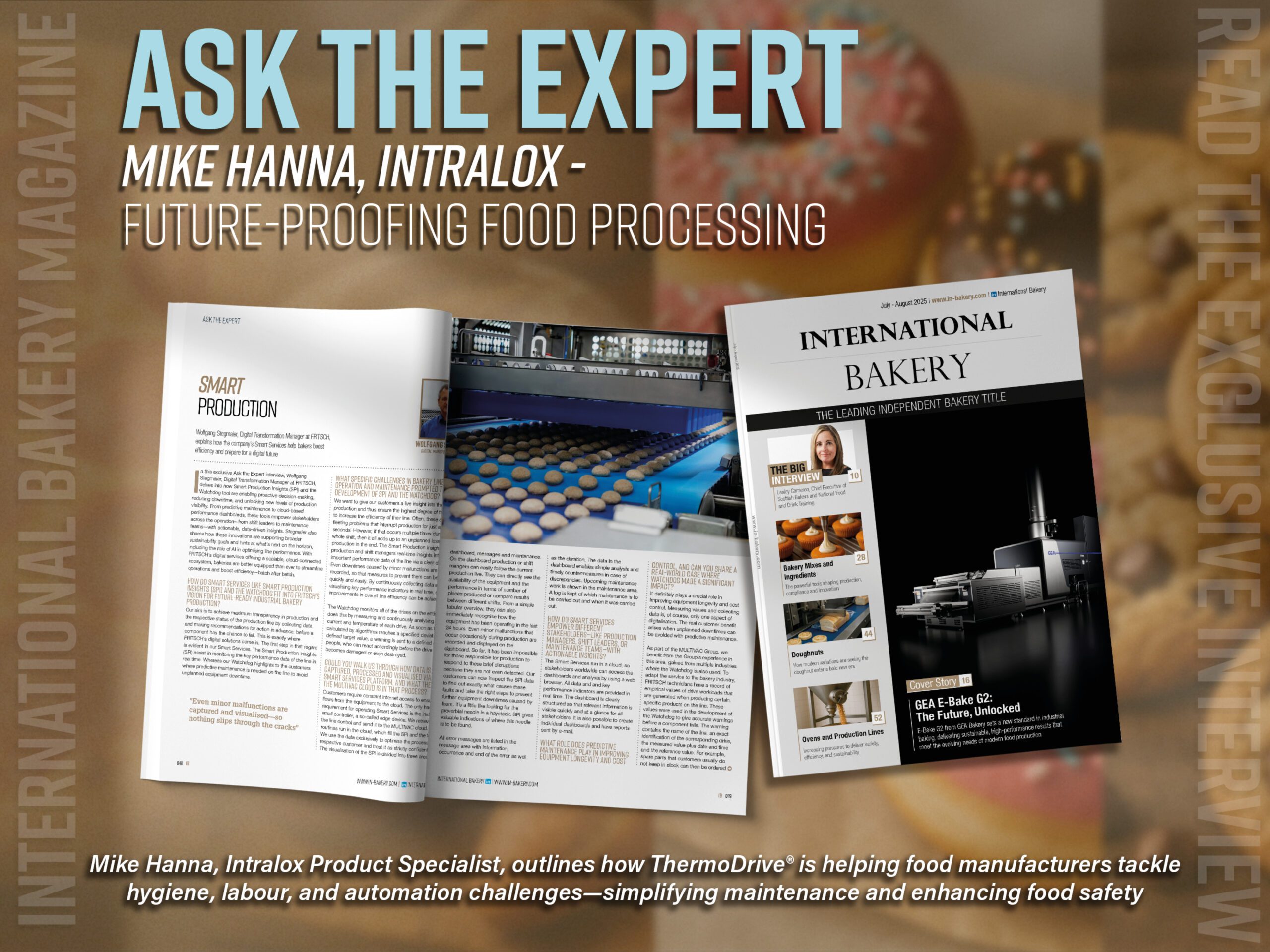

Mike Hanna, Intralox Product Specialist, outlines how ThermoDrive® is helping food manufacturers tackle hygiene, labour, and automation challenges—simplifying maintenance and enhancing food safety
What are the core concerns that flat belts pose from a hygiene, safety, and operational standpoint?
Flat belts present several significant concerns from both hygiene and operational perspectives. From a food safety standpoint, they carry a higher risk due to potential foreign material contamination (FMC) and are often absorbent, making them a harborage point for bacteria and food residues. Because flat belts are typically installed under tension, they fit tightly around the conveyor, which limits access to internal components and makes thorough cleaning more difficult. Operationally, flat belts require regular tensioning and tracking, as well as take-up systems, all of which contribute to increased maintenance demands and lead to a higher overall cost of ownership.
From your experience, what are the most common misconceptions that food manufacturers still have about flat belts—and why do they persist despite the risks?
One of the most common misconceptions among food manufacturers is the belief that flat belts do not pose significant food safety risks. These risks are often not immediately visible or understood, which leads to them being underestimated. Many manufacturers continue to rely on flat belts because they are a familiar and widely accepted technology, and there is a perception that they offer a low cost of ownership. This combination of familiarity and perceived affordability contributes to the continued use of flat belts, despite their associated risks.
Can you walk us through how ThermoDrive belts solve the problems inherent to flat belt systems—especially regarding tension, sanitation, and maintenance?
ThermoDrive belts effectively address the core issues associated with flat belt systems by reducing the risk to food safety and removing the need for tensioning, tracking, and take-up mechanisms. They offer reliable and consistent positive drive performance, which enhances operational predictability. From a hygiene perspective, ThermoDrive belts support more consistent and accessible cleaning processes, promoting improved sanitary performance. In addition, they significantly reduce the time and materials required for cleaning, which lowers maintenance requirements and contributes to greater operational efficiency.
ThermoDrive has been described as “tensionless belting.” What does that mean in practice, and how does it translate into cost savings or reduced downtime for processors?
The term “tensionless belting” refers to the fact that ThermoDrive belts operate without the need for tensioning or tracking systems. In practice, this simplifies operations significantly—eliminating issues such as belt slip thanks to its positive drive mechanism. It also extends belt life by avoiding the wear and tear caused by tension-related stress. Because there is no requirement for take-up or tracking systems, the belt design reduces mechanical complexity and daily maintenance needs. As a result, processors benefit from more reliable and predictable belt performance, as well as open access for easy cleaning—ultimately leading to lower maintenance costs and reduced operational downtime.
Intralox also offers Modular Plastic Belting. How does this solution differ from ThermoDrive, and how should decision-makers choose between the two?
Modular Plastic Belting (MPB) is constructed using plastic modules connected by hinges and rods and operates using a positive drive system. In contrast, ThermoDrive is a homogeneous thermoplastic belt with a fully closed, monolithic surface that is also positively driven. While both are designed to enhance performance and hygiene, their suitability depends on specific application requirements. At Intralox, we work closely with customers to understand their processing needs, operational expectations, and hygiene requirements. Based on this collaboration, we recommend the most suitable solution—whether MPB or ThermoDrive—ensuring the highest value for each individual application.
How does ThermoDrive’s hygienic design help food processors meet or exceed regulatory standards in terms of cleanability and sanitation validation?
ThermoDrive belts are made from a homogeneous thermoplastic material that complies with global performance and hygiene standards for direct food contact. Their non-absorbent construction and two-dimensional, fully closed surface eliminate harborage points for bacteria and food particles. The monolithic design not only supports superior sanitation but also makes validation processes more straightforward. Additionally, ThermoDrive belts are lightweight, which further facilitates handling and efficient cleaning—helping food processors to meet or exceed regulatory expectations for hygiene and cleanability.
Are there specific sectors or food product categories where you’ve seen particularly strong performance gains after switching from flat belts to ThermoDrive? Could you share an example or success story?
We have seen significant performance improvements across a broad range of food processing sectors following the switch from flat belts to ThermoDrive. In particular, strong gains have been achieved in bakery applications such as dough handling and pizza production, as well as in potato processing and snack manufacturing, including potato chip production. Customers in these sectors have experienced much longer belt life, improved cleanability, and a notable reduction in food safety risks—delivering measurable value across both hygiene and operational performance.
What role does ThermoDrive play in future-proofing food processing operations—from automation compatibility to addressing labour and sustainability challenges?
ThermoDrive belts contribute significantly to future-proofing food processing operations through their hygienic, efficient, and automation-friendly design. Key benefits include:
- Sanitary design: The smooth, thermoplastic surface supports hygienic automation by reducing contamination risks—essential for robotic food handling environments.
- Low tension and positive drive: These features enable accurate belt tracking and consistent performance, which are crucial for synchronised automation processes such as robotic pick-and-place and automated inspection systems.
- Modular adaptability: ThermoDrive systems can be tailored to fit a wide range of conveyor configurations, making them ideal for facilities with evolving automation requirements.
- Reduced manual cleaning: Compared to traditional fabric belts, ThermoDrive belts are significantly easier and faster to clean, reducing downtime and the need for manual labour during sanitation.
- Improved uptime: Their durability and low-maintenance design decrease the frequency of belt replacements and repairs, allowing operations to run efficiently with leaner teams.
- Water and chemical savings: Compatibility with clean-in-place (CIP) systems and a hygienic design help reduce the consumption of water and harsh cleaning agents.
- Waste reduction: The smooth surface minimises product loss due to sticking or damage, contributing to lower food waste levels.
- Energy efficiency: Low-tension operation leads to reduced energy consumption compared to traditional belt systems.
Read the full interview in our latest issue here