

From Recipe to Reality

Senior Editor Joseph Clarke speaks with Roland Thiemann, Show Director of Anuga FoodTec, about how automation, AI, energy efficiency and transferable technologies are helping bakers industrialise more complex products without compromising quality, flexibility or process stability….

In Brief

Anuga FoodTec Show Director Roland Thiemann discusses how automation, AI and energy-efficient technologies are helping industrial bakers manage increasingly complex products and production demands. He highlights developments in fermentation, sourdough, enzyme systems, high-hydration doughs and gluten-free products, while pointing to transferable technologies such as automated cleaning, precision dosing, robotics, image inspection and digital twins. Thiemann also explains how greater line integration can improve flexibility, traceability and consistency, while making smaller batch sizes more economically viable.
Roland Innovator

Share this article:

Senior Editor Joseph Clarke speaks with Roland Thiemann, Show Director of Anuga FoodTec, about how automation, AI, energy efficiency and transferable technologies are helping bakers industrialise more complex products without compromising quality, flexibility or process stability.

Mr Thiemann, what is the current origin of the especially great movement in the baked goods industry?

Many innovations originate from the wish for products that are nutritionally interesting and nonetheless really taste good. This is joined by another decisive question for industrial production: can such concepts be stably manufactured in larger quantities? Called for are baked goods rich in protein or fibre. Gut-friendly recipes are also gaining importance. Manufacturers are also working on less sugar and on lists of ingredients that remain comprehensible for consumers. The following applies for all of this: flavour and texture must be convincing.

In terms of technology, much is happening with fermentation and sourdough. Enzyme systems open up additional possibilities, as do new flour combinations. This means that freshness and digestibility can be improved without losing track of process stability.

A great deal of movement is also apparent in doughs with high water content. For once, this can be taken literally in the case of doughs. Seriously: gluten-free baked goods are developing just as dynamically. Plant-based concepts are making progress, as are frozen products. The actual trick consists in transporting new recipes into production in such a way that quality and economic efficiency are compatible.

While we’re talking about new recipes: what technologies from other sectors of food production might be of help to the baked goods industry?

Taking a broader view really pays here. For example, solutions for hygienic design and automated cleaning come from milk and beverage processing. Precise dosing systems simplify the handling of fillings and creams. Controlled allergen management can also be supported in this way.

There is also a great deal relating to quality control that can be transferred in the meantime. Image processing and X-ray inspection already test products on the line. Robotics assume flexible handling tasks. Digital twins visualise processes virtually and make it possible to better evaluate changes. That reinforces quality control and improves traceability. At the same time, production can react more flexibly.

Also interesting is vacuum cooling. Selected procedures for preservation can increase the throughput and extend keepability. However, one can’t simply adopt such technologies from another industry. They must be suitable for the properties of the respective baked good and the concrete process.

What is automation changing in the industrial production of baked goods in concrete terms?

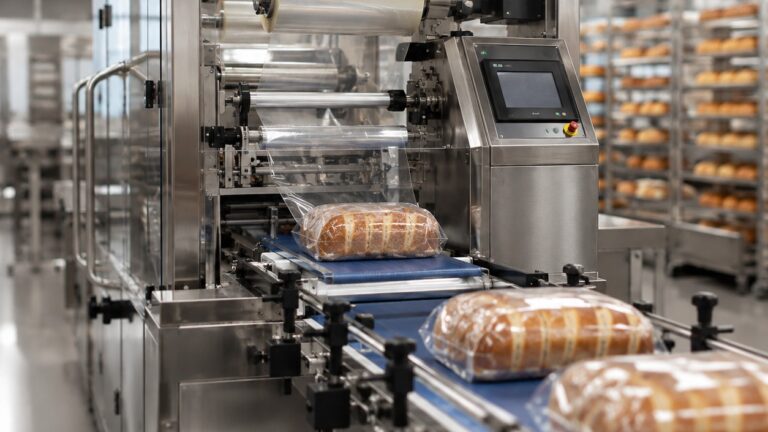
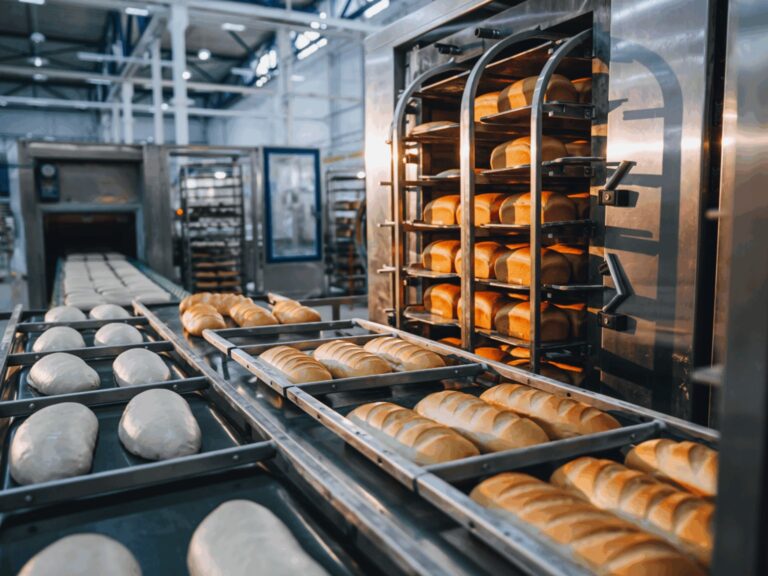
It increasingly connects the entire line. That starts with the handling of the ingredients and leads through dough preparation to the baking process. Packaging and palletising are then incorporated. Individual machines then become a coherent production system, in which material flows and information are better coordinated with one another.

That helps with a problem that many manufacturers face daily: the lack of a qualified workforce. Automated systems can assume recurring tasks and ensure more consistent results. Hygiene can also be better assured. The same applies for traceability.

Automation becomes especially interesting for smaller batch sizes. Camera-guided robots and rapid, automatic format changes make shorter production runs more economically efficient. Assortments rich in variants can thus be more flexibly covered without each change causing long interruptions. Automation then not only increases the performance of large lines. It can also make smaller quantities economically possible.


Read the full interview here

About International Bakery

International Bakery is the leading authority in global bakery content, delivering expert news, in-depth articles, exclusive interviews, and industry insights across print, digital, and event platforms. Published 10 times a year, the magazine is a trusted resource for professionals seeking updates and analysis on the latest developments in the bakery sector.

To submit an article, or for sponsorship opportunities, please contact our team below.

Joseph Clarke Picture

Joseph Clarke

Senior Editor

Steve Blakebrough Picture

Steve Blakebrough

Sales Manager

Afua Akoto Picture

Afua Akoto

Marketing Manager

Related News

Roland Innovator

From Recipe to Reality

Senior Editor Joseph Clarke speaks with Roland Thiemann, Show Director of Anuga FoodTec, about how automation, AI, energy efficiency and transferable technologies are helping bakers industrialise more complex products without compromising quality, flexibility or process stability.
DELIFRANCE_Assortment

Vandemoortele and Délifrance unite

Vandemoortele and Délifrance can now operate as one following clearance of their transaction by the UK Competition and Markets Authority (CMA), marking the start of a new chapter for the two bakery businesses.
Matthew Jones

Bread Ahead, and Beyond

Bread Ahead founder Mathew Jones discusses the enduring appeal of sourdough and doughnuts, taking the concept overseas and why developing the next generation of bakers has become central to his ambitions.
GEA Pack Expo

Pack Expo Exhibitor – GEA Bakery

GEA Bakery offers engineering precision, driving Innovation and helping manufacturers achieve greater flexibility, consistency and efficiency across modern bakery production.
GEA From the Expert

Rethinking innovation in industrial baking

Fabio Del Prete, Senior Vice President at GEA Bakery outlines how technology, data and collaboration are helping bakery manufacturers balance efficiency, flexibility and product quality.
St Pierre 4 Mediterranean Herb

St. Pierre Targets Lunchtime

St Pierre, one of the UK’s leading premium bakery brands, is expanding into lunchtime occasions with the launch of Soft Pretzel Rolls and Mediterranean Herb Brioche Rolls.
FRITSCH 100

Fritsch – Celebrating 100 Years!

In the world of bakery technology, the name FRITSCH has been synonymous with German engineering and dough processing for 100 years.  
Lovingly Artisan

Lovingly Artisan re-launches baking club

Lovingly Artisan, the multi-award-winning bakery duo based in Manchester and Cumbria, is delighted to announce the re-launch of its much-loved virtual Baking Club, a free, welcoming home for bread lovers of every level, hosted on Facebook.
Food Centre Buhler

Where food ideas take shape

Bühler’s Consumer Foods Application Centers provide an environment where manufacturers can explore these relationships, produce samples and prepare for industrial production without interrupting their own manufacturing operations. 
RAPS Fi Europe

RAPS combines taste with functionality

RAPS will showcase its ingredient expertise, expanded extraction capabilities and savoury solutions at Food Ingredients Europe 2026 in Frankfurt from 17–19 November.
Scroll to Top