
Barilla has highlighted its continued investment in regenerative agriculture, renewable energy and sustainable manufacturing as part of the publication of its 2025 Sustainability Report, outlining several initiatives relevant to the bakery sector.
Among the developments is the company’s continued expansion of regenerative agriculture practices for soft wheat, alongside investments in renewable electricity generation across its pasta and bakery production sites.
The report, released to coincide with World Environment Day, also follows Barilla being named the world’s most reputable company in the food sector for the third consecutive year and, for the first time, securing a place among the global top 10 in the Global RepTrak 100 2026 rankings.
“The future of the planet will increasingly depend on our ability to spread culture and education,” said Paolo Barilla, Vice Chairman of the Barilla Group. “For Barilla, this means caring for communities, promoting strong values, and investing in technologies and production systems that protect the environment and safeguard people’s health.”
Innovation also remains a priority for the Group, with more than €47 million invested in Research, Development and Quality during 2025. The company recently established BITE (Barilla Innovation & Technology Experience), its new global innovation hub in Parma, where more than 200 food technologists, researchers, food designers, chefs and sensory experts collaborate with a network of 84 universities and research centres to develop new products and industrial processes.
Powering more sustainable bakery production
A significant focus of the report is Barilla’s ongoing investment in its manufacturing operations. During 2025, the company invested €30 million as part of a broader €168 million five-year programme running through to 2030, covering energy efficiency, renewable electricity generation and sustainable water management across its production sites.
Five new photovoltaic installations commissioned during the year at facilities in Foggia, Melfi, Ascoli Piceno and Cremona in Italy, together with Thiva in Greece, increased installed photovoltaic capacity across Barilla’s production sites to more than 8MW—more than four times higher than in 2022.
The company also reported significant progress in water conservation, stating that recycled and reused water at production sites located in water-stressed areas increased by 196% compared with 2022, supporting its target of achieving a 250% increase by 2030.
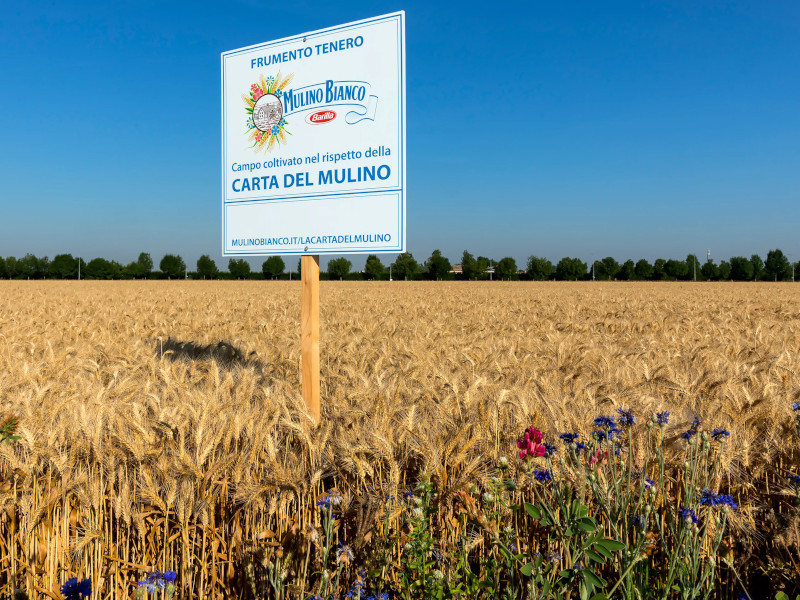
For bakery manufacturers, one of the report’s most relevant developments is Barilla’s continued expansion of regenerative agriculture across its wheat supply chain.
In 2025, the company purchased 4,160 tonnes of soft wheat produced using regenerative agriculture practices, with a target of sourcing 250,000 tonnes by 2030. The initiative aims to restore soil health and biodiversity while reducing water use.
Through its Barilla Sustainable Farming (BSF) programme, which covers key crops including cereals, the company has sourced more than 816,000 tonnes of raw materials since 2010 while working with nearly 7,000 farmers.
Building on this long-standing programme, Barilla is progressively scaling regenerative agriculture practices aligned with FAO principles, including crop rotation, minimum tillage and organic fertilisation, with the objective of improving soil health, enhancing biodiversity and reducing greenhouse gas emissions.
Alongside its environmental initiatives, Barilla continues to invest in local communities. During 2025, the company donated 4,000 tonnes of food products to non-profit organisations worldwide and allocated €2 million to social causes supporting inclusion, education and social wellbeing, while also promoting equal opportunities across its production sites.
Barilla said the latest sustainability report demonstrates how its environmental, agricultural and manufacturing investments continue to support the company’s long-term growth strategy while advancing the objectives set out in its 2030 Sustainability Compass.