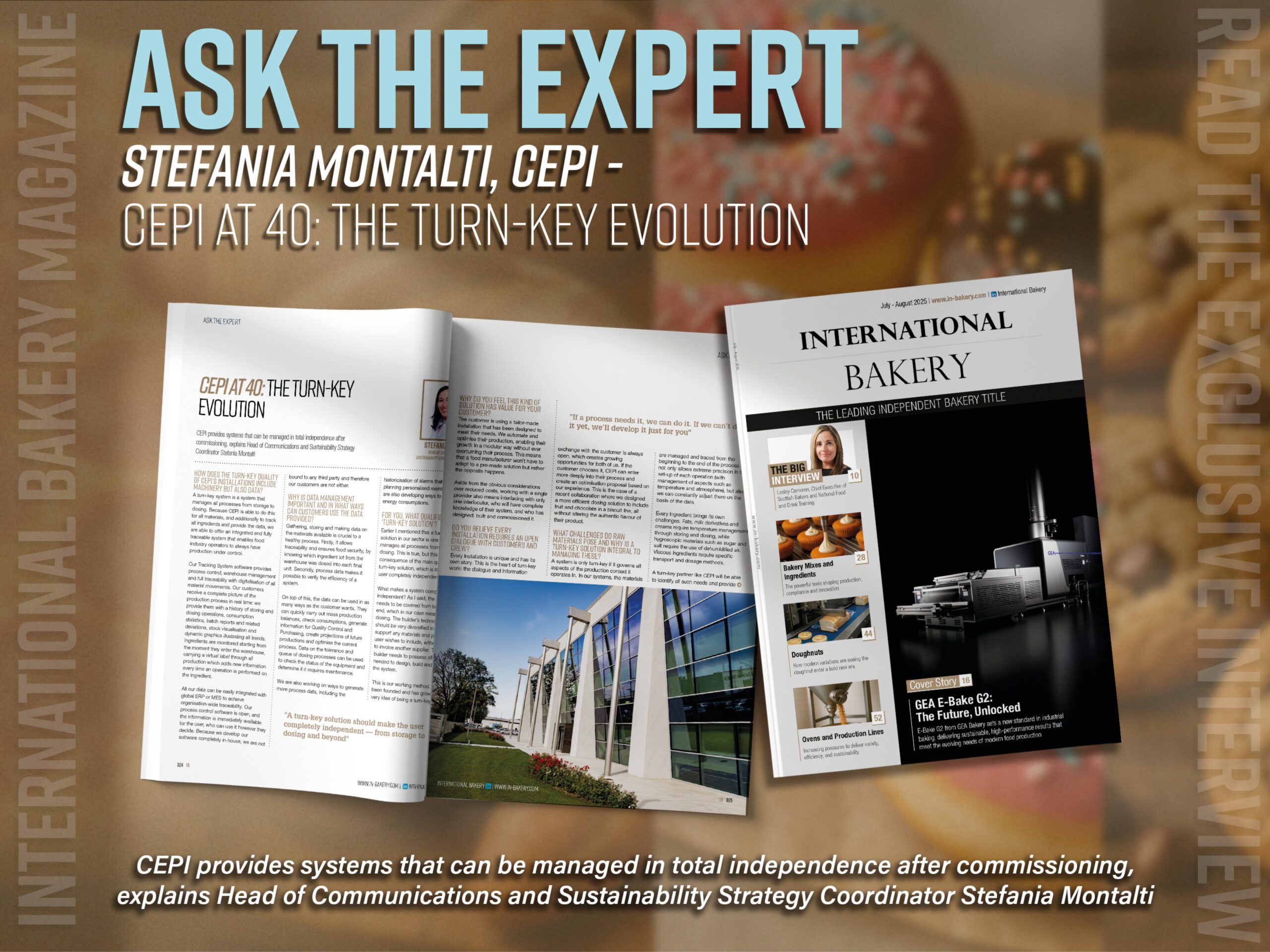

CEPI provides systems that can be managed in total independence after commissioning, explains Head of Communications and Sustainability Strategy Coordinator Stefania Montalti
How does the turn-key quality of CEPI’s installations include machinery but also data?
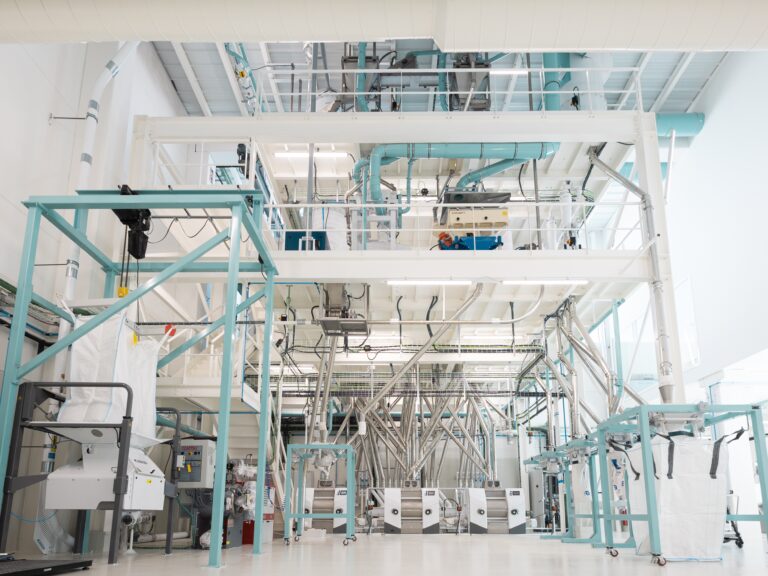
A turn-key system is a system that manages all processes from storage to dosing. Because CEPI is able to do this for all materials, and additionally to track all ingredients and provide the data, we are able to offer an integrated and fully traceable system that enables food industry operators to always have production under control.
Our Tracking System software provides process control, warehouse management and full traceability with digitalisation of all material movements. Our customers receive a complete picture of the production process in real time: we provide them with a history of storing and dosing operations, consumption statistics, batch reports and related deviations, stock visualisation and dynamic graphics illustrating all trends. Ingredients are monitored starting from the moment they enter the warehouse, carrying a virtual label through all production which adds new information every time an operation is performed on the ingredient.
All our data can be easily integrated with global ERP or MES to achieve organisation-wide traceability. Our process control software is open, and the information is immediately available for the user, who can use it however they decide. Because we develop our software completely in-house, we are not bound to any third party and therefore our customers are not either.
Why is data management important and in what ways can customers use the data provided?
Gathering, storing and making data on the materials available is crucial to a healthy process. Firstly, it allows traceability and ensures food security, by knowing which ingredient lot from the warehouse was dosed into each final unit. Secondly, process data makes it possible to verify the efficiency of a system.
On top of this, the data can be used in as many ways as the customer wants. They can quickly carry out mass production balances, check consumptions, generate information for Quality Control and Purchasing, create projections of future productions and optimise the current process. Data on the tolerance and queue of dosing processes can be used to check the status of the equipment and determine if it requires maintenance.
We are also working on ways to generate more process data, including the historicisation of alarms that can aid in planning personalised maintenance. We are also developing ways to historicise energy consumptions.
For you, what qualifies as a ‘turn-key solution’?
Earlier I mentioned that a turn-key solution in our sector is one that manages all processes from storage to dosing. This is true, but this aspect is a consequence of the main quality of a turn-key solution, which is to make the user completely independent.
What makes a system completely independent? As I said, the process needs to be covered from beginning to end, which in our case means storing to dosing. The builder’s technological offer should be very diversified in order to support any materials and processes the user wishes to include, without the need to involve another supplier. Then, the builder needs to possess all expertise needed to design, build and commission the system.
This is our working method. CEPI has been founded and has grown around the very idea of being a turn-key provider.
Why do you feel this kind of solution has value for your customer?
The customer is using a tailor-made installation that has been designed to meet their needs. We automate and optimise their production, enabling their growth in a modular way without ever overturning their process. This means that a food manufacturer won’t have to adapt to a pre-made solution but rather the opposite happens.
Aside from the obvious considerations over reduced costs, working with a single provider also means interfacing with only one interlocutor, who will have complete knowledge of their system, and who has designed, built and commissioned it.
Do you believe every installation requires an open dialogue with customers and crew?
Every installation is unique and has its own story. This is the heart of turn-key work: the dialogue and information exchange with the customer is always open, which creates growing opportunities for both of us. If the customer chooses it, CEPI can enter more deeply into their process and create an optimisation proposal based on our experience. This is the case of a recent collaboration where we designed a more efficient dosing solution to include fruit and chocolate in a biscuit line, all without altering the authentic flavour of their product.
Read the full interview in our latest issue here