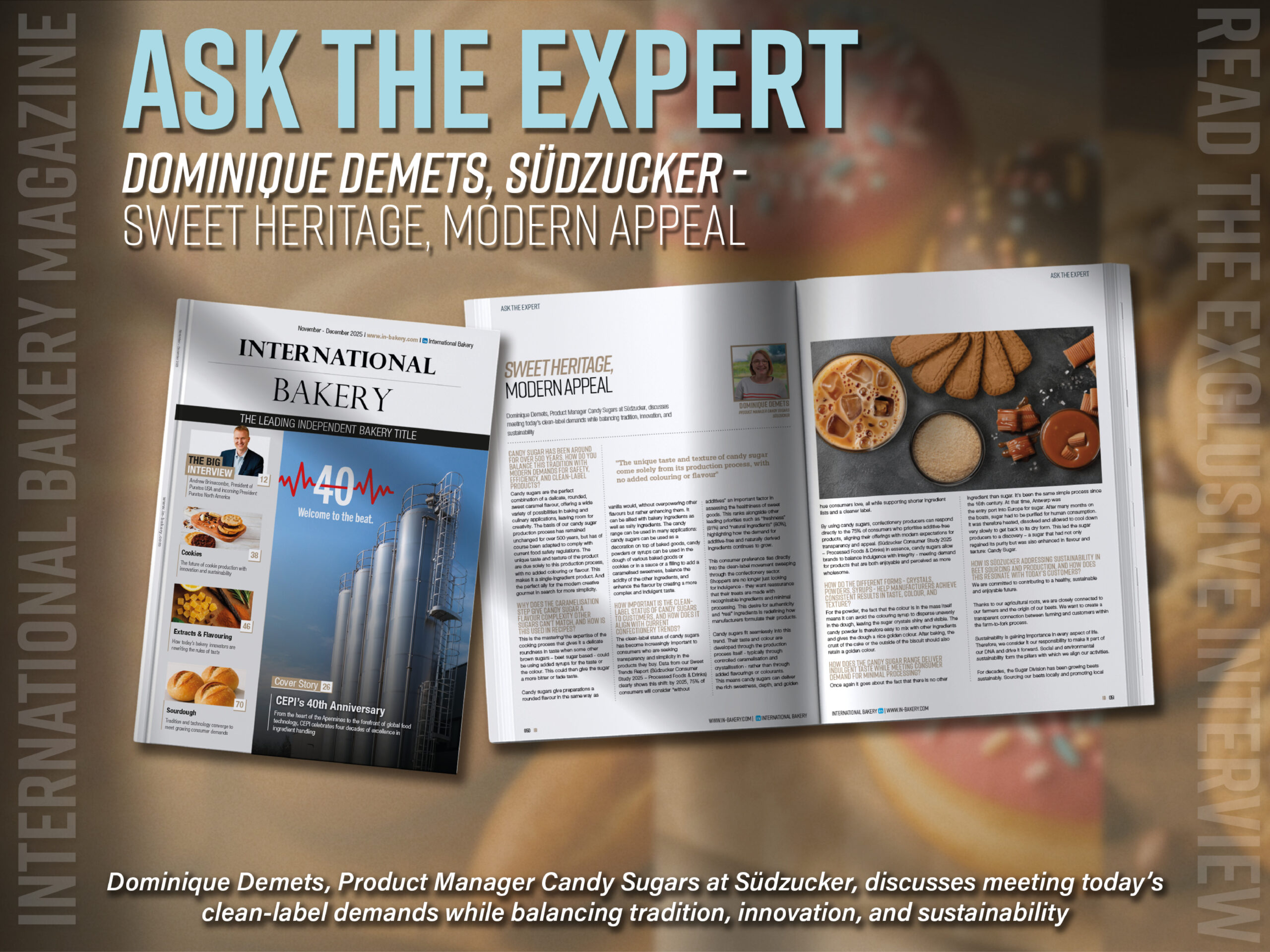

Dominique Demets, Product Manager Candy Sugars at Südzucker, discusses meeting today’s clean-label demands while balancing tradition, innovation, and sustainability
Candy sugar has been around for over 500 years. How do you balance this tradition with modern demands for safety, efficiency, and clean-label products?
Candy sugars are the perfect combination of a delicate, rounded, sweet caramel flavour, offering a wide variety of possibilities in baking and culinary applications, leaving room for creativity. The basis of our sugar candy production process has remained unchanged for over 500 years, but has of course been adapted to comply with current food safety regulations. The unique taste and texture of the product are due solely to this production process, with no added colouring or flavour. This makes it a single-ingredient product. And the perfect ally for the modern creative gourmet in search for more simplicity
Why does the caramelisation step give candy sugar a flavour complexity other sugars can’t match, and how is this used in recipes?
This is the mastering/the expertise of the cooking process that gives it a delicate roundness in taste when some other brown sugars – beet sugar based – could be using added syrups for the taste or the colour. This could then give the sugar a more bitter or fade taste.
Candy sugars give preparations a rounded flavour in the same way as vanilla would, without overpowering other flavours but rather enhancing them. It can be allied with bakery ingredients as well as salty ingredients. The candy range can be used in many applications: candy sugars can be used a decoration on top of bakeries, candy powders or syrups can be used in the dough of various bakeries or cookies or in a sauce or a filling to add a caramelised sweetness, balance the acidity of the other ingredients, and enhance the flavour by creating a more complex and indulgent taste.
How important is the clean-label status of candy sugars to customers, and how does it align with current trends?
The clean-label status of candy sugars has become increasingly important to consumers who are seeking transparency and simplicity in the products they buy. Data from our Sweet Trends Report (Südzucker Consumer Study 2025 – Processed Foods & Drinks) clearly shows this shift: by 2025, 75% of consumers will consider “without additives” an important factor in assessing the healthiness of sweet goods. This ranks alongside other leading priorities such as “freshness” (81%) and “natural ingredients” (80%), highlighting how the demand for additive-free and naturally derived ingredients continues to grow.
This consumer preference ties directly into the clean-label movement sweeping through the confectionery sector. Shoppers are no longer just looking for indulgence – they want reassurance that their treats are made with recognisable ingredients and minimal processing. The desire for authenticity and “real” ingredients is redefining how manufacturers formulate their products.
Candy sugars fit seamlessly into this trend. Their taste and colour are naturally developed through the production process itself – typically through controlled caramelisation and crystallisation – rather than through added flavourings or colourants. This means candy sugars can deliver the rich sweetness, depth, and golden hue consumers love, all while supporting shorter ingredient lists and a cleaner label.
By using candy sugars, confectionery producers can respond directly to the 75% of consumers who prioritise additive-free products, aligning their offerings with modern expectations for transparency, sustainability, and natural appeal. In essence, candy sugars allow brands to balance indulgence with integrity – meeting demand for products that are both enjoyable and perceived as more wholesome.
How do the different forms – crystals, powders, syrups – help manufacturers achieve consistent results in taste, colour, and texture?
For the powder, the fact that the colour is in the mass itself means it can avoid the colouring syrup to disperse unevenly in the dough, leaving the sugar crystals shiny and visible. The candy powder remains fluid, easy to mix with other ingredients and gives the dough a nice golden colour. After baking, the crust of the cake or the outside of the biscuit should also retain a golden colour.
How does the candy sugar range deliver indulgent taste while meeting consumer demand for naturalness and minimal processing?
Once again it goes about the fact that there is no other ingredient than sugar. The process – the same simple basic since the 16th century. At that time, Antwerp was the entry port into Europe for sugar. After many months on the boats, sugar had to be purified for human consumption. It was therefore heated, dissolved and allowed to cool down very slowly to get back to its dry form. This led the sugar producers to a discovery – a sugar that had not only regained its purity but was also enhanced in flavour and texture: Candy Sugar.
How is Südzucker addressing sustainability in beet sourcing and production, and how does this resonate with today’s customers?
We are committed to contributing to a healthy, sustainable and enjoyable future.
Thanks to our agricultural roots, we are closely connected to our farmers and the origin of our beets. We want to create a transparent connection between farming and customers within the farm-to-fork process.
Sustainability is gaining importance in every aspect of life. Therefore, we consider it our responsibility to make it part of our DNA and drive it forward. Social and environmental sustainability form the pillars with which we align our activities.
Read the full interview in our latest issue here