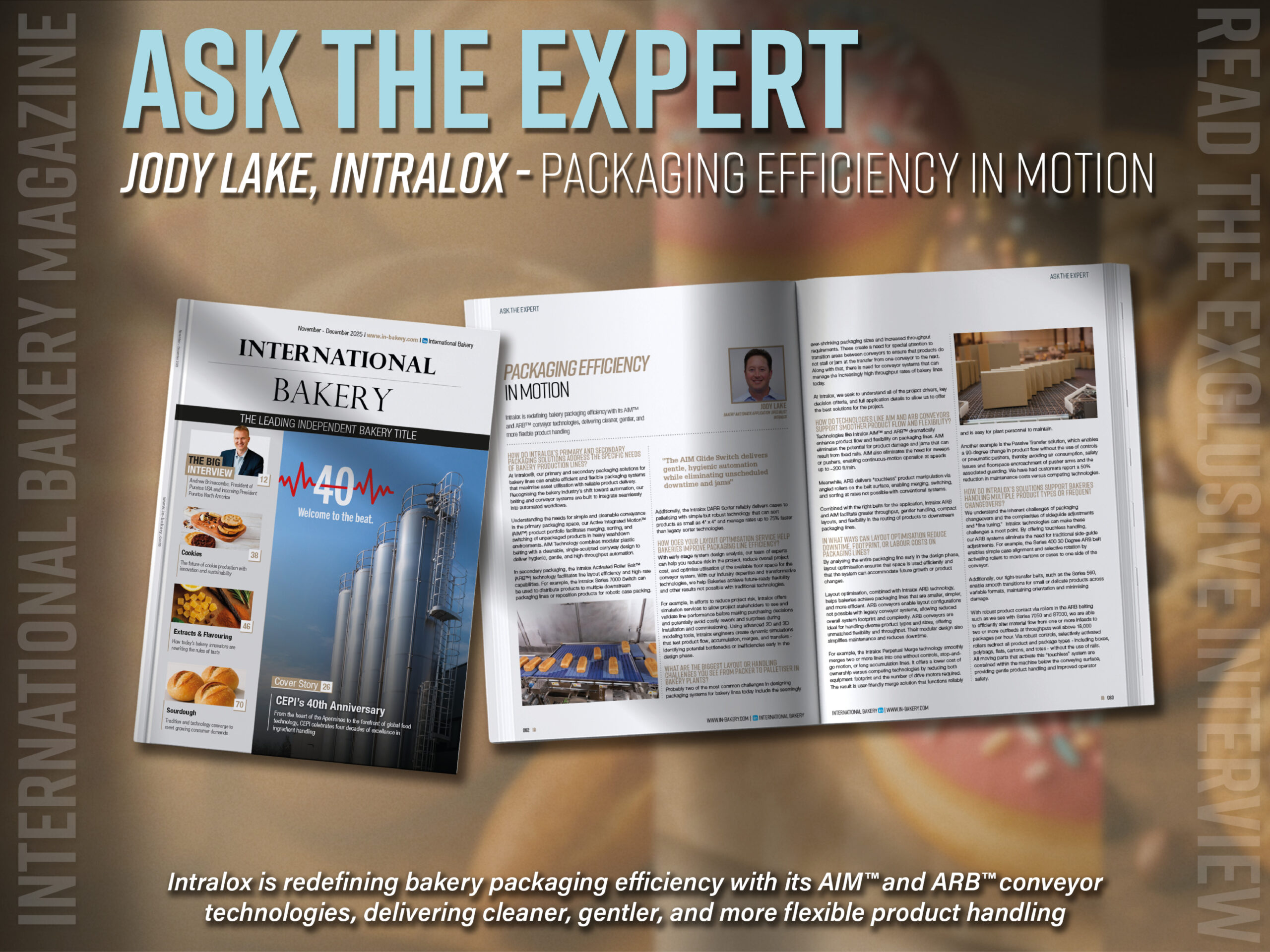

Intralox is redefining bakery packaging efficiency with its AIM™ and ARB™ conveyor technologies, delivering cleaner, gentler, and more flexible product handling
How do Intralox’s primary and secondary packaging solutions address the specific needs of bakery production lines?
At Intralox®, our primary and secondary packaging solutions for bakery lines can enable efficient and flexible packaging systems that maximise asset utilisation with reliable product delivery. Recognising the bakery industry’s shift toward automation, our belting and conveyor systems are built to integrate seamlessly into automated workflows.
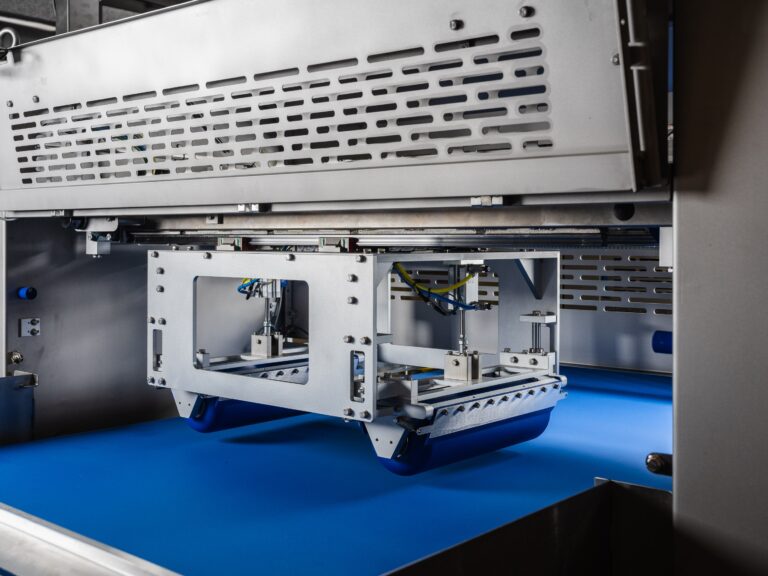
Understanding the needs for simple and cleanable conveyance in the primary packaging space, our Active Integrated Motion™ (AIM™) product portfolio facilitates merging, sorting, and switching of unpackaged products in heavy washdown environments. AIM Technology combines modular plastic belting with a cleanable, single-sculpted carryway design to deliver hygienic, gentle, and high-throughput automation.
In secondary packaging, the Intralox Activated Roller Belt™ (ARB™) technology facilitates line layout efficiency and high-rate capabilities. For example, the Intralox Series 7000 Switch can be used to distribute products to multiple downstream packaging lines or reposition products for robotic case packing. Additionally, the Intralox DARB Sorter reliably delivers cases to palletising with simple but robust technology that can sort products as small as 4” x 4” and manage rates up to 75% faster than legacy sorter technologies.
How does your Layout Optimisation Service help bakeries improve packaging line efficiency?
With early-stage system design analysis, our team of experts can help you reduce risk in the project, reduce overall project cost, and optimise utilisation of the available floor space for the conveyor system. With our industry expertise and transformative technologies, we help Bakeries achieve future-ready flexibility and other results not possible with traditional technologies.
For example, in efforts to reduce project risk, Intralox offers simulation services to allow project stakeholders to see and validate line performance before making purchasing decisions and potentially avoid costly rework and surprises during installation and commissioning. Using advanced 2D and 3D modeling tools, Intralox engineers create dynamic simulations that test product flow, accumulation, merges, and transfers – identifying potential bottlenecks or inefficiencies early in the design phase.
What are the biggest layout or handling challenges you see from packer to palletiser in bakery plants?
Probably two of the most common challenges in designing packaging systems for bakery lines today include the seemingly ever-shrinking packaging sizes and increased throughput requirements. These create a need for special attention to transition areas between conveyors to ensure that products do not stall or jam at the transfer from one conveyor to the next. Along with that, there is need for conveyor systems that can manage the increasingly high throughput rates of bakery lines today.
At Intralox, we seek to understand all of the project drivers, key decision criteria, and full application details to allow us to offer the best solutions for the project.
How do technologies like AIM and ARB conveyors support smoother product flow and flexibility?
Technologies like Intralox AIM™ and ARB™ dramatically enhance product flow and flexibility on packaging lines. AIM eliminates the potential for product damage and jams that can result from fixed rails. AIM also eliminates the need for sweeps or pushers, enabling continuous-motion operation at speeds up to ~200 ft/min.
Meanwhile, ARB delivers “touchless” product manipulation via angled rollers on the belt surface, enabling merging, switching, and sorting at rates not possible with conventional systems.
Combined with the right belts for the application, Intralox ARB and AIM facilitate greater throughput, gentler handling, compact layouts, and flexibility in the routing of products to downstream packaging lines.
Read the full article in our latest issue here