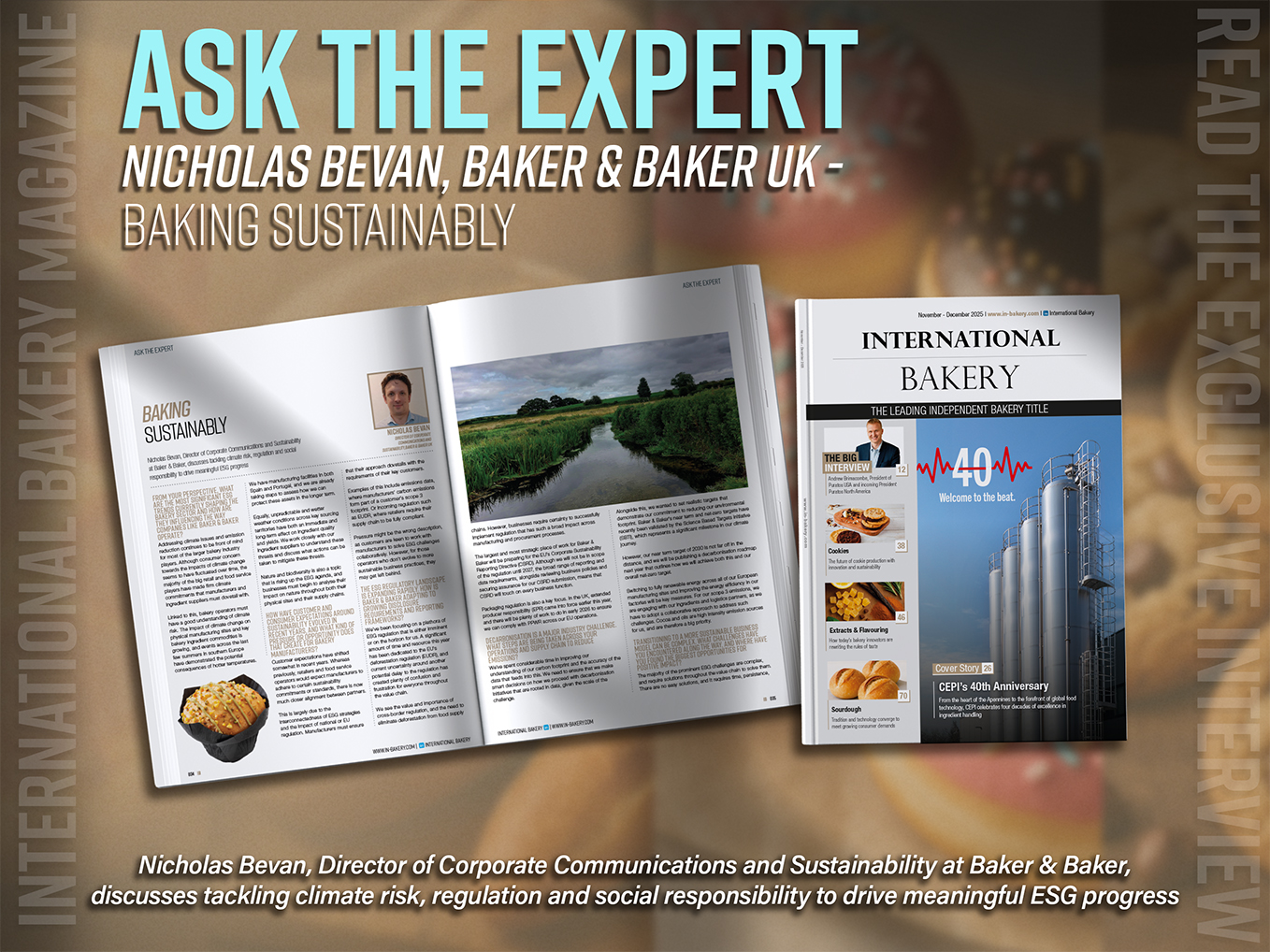

Nicholas Bevan, Director of Corporate Communications and Sustainability at Baker & Baker, discusses tackling climate risk, regulation and social responsibility to drive meaningful ESG progress
From your perspective, what are the most significant ESG trends currently shaping the bakery sector and how are they influencing the way companies like Baker & Baker operate?
Addressing climate issues and emission reduction continues to be front of mind for most of the larger bakery industry players. Although consumer concern towards the impacts of climate change seems to have fluctuated over time, the majority of the big retail and food service players have made firm climate commitments that manufacturers and ingredient suppliers must dovetail with.
Linked to this, bakery operators must have a good understanding of climate risk. The impact of climate change on physical manufacturing sites and key bakery ingredient commodities is growing, and events across the last few summers in southern Europe have demonstrated the potential consequences of hotter temperatures. We have manufacturing facilities in both Spain and Portugal, and we are already taking steps to assess how we can protect these assets in the longer term.
Equally, unpredictable and wetter weather conditions across key sourcing territories have both an immediate and long-term effect on ingredient quality and yields. We work closely with our ingredient suppliers to understand these threats and discuss what actions can be taken to mitigate these threats.
Nature and biodiversity is also a topic that is rising up the ESG agenda, and businesses must begin to analyse their impact on nature throughout both their physical sites and their supply chains.
How have customer and consumer expectations around sustainability evolved in recent years, and what kind of pressure or opportunity does that create for bakery manufacturers?
Customer expectations have shifted somewhat in recent years. Whereas previously, retailers and food service operators would expect manufacturers to adhere to certain sustainability commitments or standards, there is now much closer alignment between partners.
This is largely due to the interconnectedness of ESG strategies and the impact of national or EU regulation. Manufacturers must ensure that their approach dovetails with the requirements of their key customers.
Examples of this include emissions data, where manufacturers’ carbon emissions form part of a customer’s scope 3 footprint. Or incoming regulation such as EUDR, where retailers require their supply chain to be fully compliant.
Pressure might be the wrong description, as customers are keen to work with manufacturers to solve ESG challenges collaboratively. However, for those operators who don’t evolve to more sustainable business practices, they may get left behind.
The ESG regulatory landscape is expanding rapidly. How is Baker & Baker adapting to growing disclosure requirements and reporting frameworks?
We’ve been focusing on a plethora of ESG regulation that is either imminent or on the horizon for us. A significant amount of time and resource this year has been dedicated to the EU’s deforestation regulation (EUDR), and current uncertainty around another potential delay to the regulation has created plenty of confusion and frustration for everyone throughout the value chain.
We see the value and importance of cross-border regulation, and the need to eliminate deforestation from food supply chains. However, businesses require certainty to successfully implement regulation that has such a broad impact across manufacturing and procurement processes.
The largest and most strategic piece of work for Baker & Baker will be preparing for the EU’s Corporate Sustainability Reporting Directive (CSRD). Although we will not be in scope of the regulation until 2027, the broad range of reporting and data requirements, alongside reviewing business policies and securing assurance for our CSRD submission, means that CSRD will touch on every business function.
Packaging regulation is also a key focus. In the UK, extended producer responsibility (EPR) came into force earlier this year, and there will be plenty of work to do in early 2026 to ensure we can comply with PPWR across our EU operations.
Decarbonisation is a major industry challenge. What steps are being taken across your operations and supply chain to reduce emissions?
We’ve spent considerable time in improving our understanding of our carbon footprint and the accuracy of the data that feeds into this. We need to ensure that we make smart decisions on how we proceed with decarbonisation initiatives that are rooted in data, given the scale of the challenge.
Alongside this, we wanted to set realistic targets that demonstrate our commitment to reducing our environmental footprint. Baker & Baker’s near term and net-zero targets have recently been validated by the Science Based Targets initiative (SBTi), which represents a significant milestone in our climate journey.
However, our near term target of 2030 is not far off in the distance, and we will be publishing a decarbonisation roadmap next year that outlines how we will achieve both this and our overall net-zero target.
Switching to fully renewable energy across all of our European manufacturing sites and improving the energy efficiency in our factories will be key measures. For our scope 3 emissions, we are engaging with our ingredients and logistics partners, as we have to adopt a collaborative approach to address such challenges. Cocoa and oils are high intensity emission sources for us, and are therefore a big priority.
Read the full interview in our latest issue here