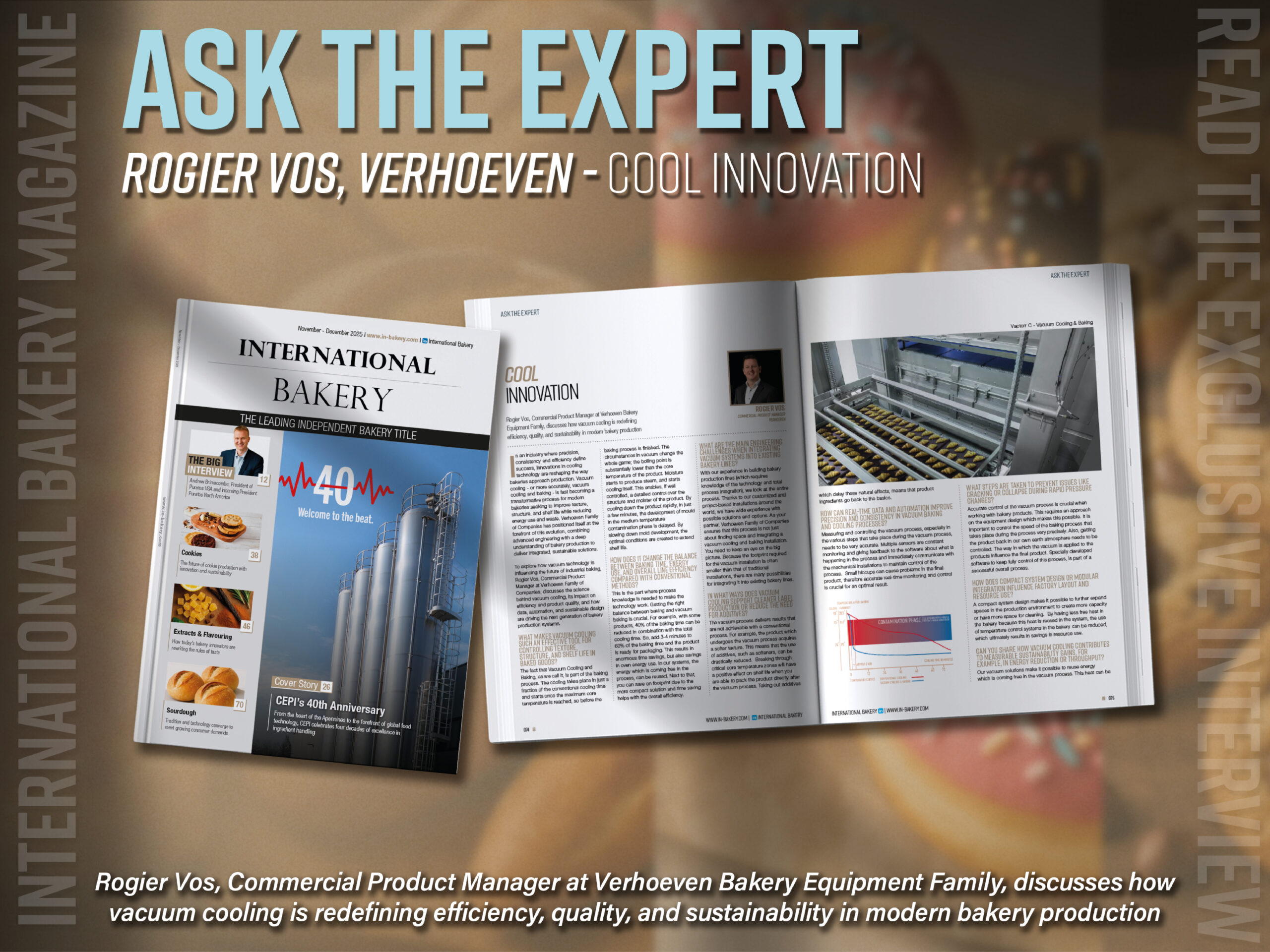

Rogier Vos, Commercial Product Manager at Verhoeven Bakery Equipment Family, discusses how vacuum cooling is redefining efficiency, quality, and sustainability in modern bakery production
In an industry where precision, consistency and efficiency define success, innovations in cooling technology are reshaping the way bakeries approach production. Vacuum cooling – or more accurately, vacuum baking and cooling – is fast becoming a transformative process for modern bakeries seeking to improve texture, structure, and shelf life while reducing energy use and waste. Verhoeven Family of Companies has positioned itself at the forefront of this evolution, combining advanced engineering with a deep understanding of bakery production to deliver integrated, sustainable solutions.
To explore how vacuum technology is influencing the future of industrial baking, Rogier Vos, Commercial Product Manager at Verhoeven Family of Companies, discusses the science behind vacuum cooling, its impact on efficiency and product quality, and how data, automation, and sustainable design are driving the next generation of bakery production systems.
What makes vacuum cooling such an effective tool for controlling texture, structure, and shelf life in baked goods?
The fact that Vacuum Cooling and Baking, as we call it, is part of the baking process. The cooling takes place in just a fraction of the conventional cooling time and starts once the maximum core temperature is reached, so before the baking process is finished. The circumstances in vacuum change the whole game; the boiling point is substantially lower than the core temperature of the product. Moisture starts to produce steam, and starts cooling itself. This enables, if well controlled, a detailed control over the structure and moister of the product. By cooling down the product rapidly, in just a few minutes, the development of mould in the medium-temperature contamination phase is delayed. By slowing down mold development, the optimal conditions are created to extend shelf life.
How does it change the balance between baking time, energy use, and overall line efficiency compared with conventional methods?
This is the part where process knowledge is needed to make the technology work. Getting the right balance between baking and vacuum baking is crucial. For example, with some products, 40% of the baking time can be reduced in combination with the total cooling time. So, add 3-4 minutes to 60% of the baking time and the product is ready for packaging. This results in enormous time savings, but also savings in oven energy use. In our systems, the energy which is coming free in the process, can be reused. Next to that, you can save on footprint due to the more compact solution and time saving helps with the overall efficiency.
What are the main engineering challenges when integrating vacuum systems into existing bakery lines?
With our experience in building bakery production lines (which requires knowledge of the technology and total process integration), we look at the entire process. Thanks to our customized and project-based installations around the world, we have wide experience with possible solutions and options. As your partner, Verhoeven Family of Companies ensures that this process is not just about finding space and integrating a vacuum cooling and baking installation. You need to keep an eye on the big picture. Because the footprint required for the vacuum installation is often smaller than that of traditional installations, there are many possibilities for integrating it into existing bakery lines.
In what ways does vacuum cooling support cleaner label production or reduce the need for additives?
The vacuum process delivers results that are not achievable with a conventional process. For example, the product which undergoes the vacuum process acquires a softer texture. This means that the use of additives, such as softeners, can be drastically reduced. Breaking through critical core temperature zones will have a positive effect on shelf life when you are able to pack the product directly after the vacuum process. Taking out additives which delay these natural effects, means that product ingredients go back to the basics.
How can real-time data and automation improve precision and consistency in vacuum baking and cooling processes?
Measuring and controlling the vacuum process, especially in the various steps that take place during the vacuum process, needs to be very accurate. Multiple sensors are constant monitoring and giving feedback to the software about what is happening in the process and immediately communicate with the mechanical installations to maintain control of the process. Small hiccups can cause problems in the final product, therefore accurate real-time monitoring and control is crucial for an optimal result.
What steps are taken to prevent issues like cracking or collapse during rapid pressure changes?
Accurate control of the vacuum process is crucial when working with bakery products. This requires an approach on the equipment design which makes this possible. It is important to control the speed of the baking process that takes place during the process very precisely. Also, getting the product back in our own earth atmosphere needs to be controlled. The way in which the vacuum is applied to the products influence the final product. Specially developed software to keep fully control of this process, is part of a successful overall process.
How does compact system design or modular integration influence factory layout and resource use?
A compact system design makes it possible to further expand spaces in the production environment to create more capacity or have more space for cleaning. By having less free heat in the bakery because this heat is reused in the system, the use of temperature control systems in the bakery can be reduced, which ultimately results in savings in resource use.
Read the full interview in our latest issue here