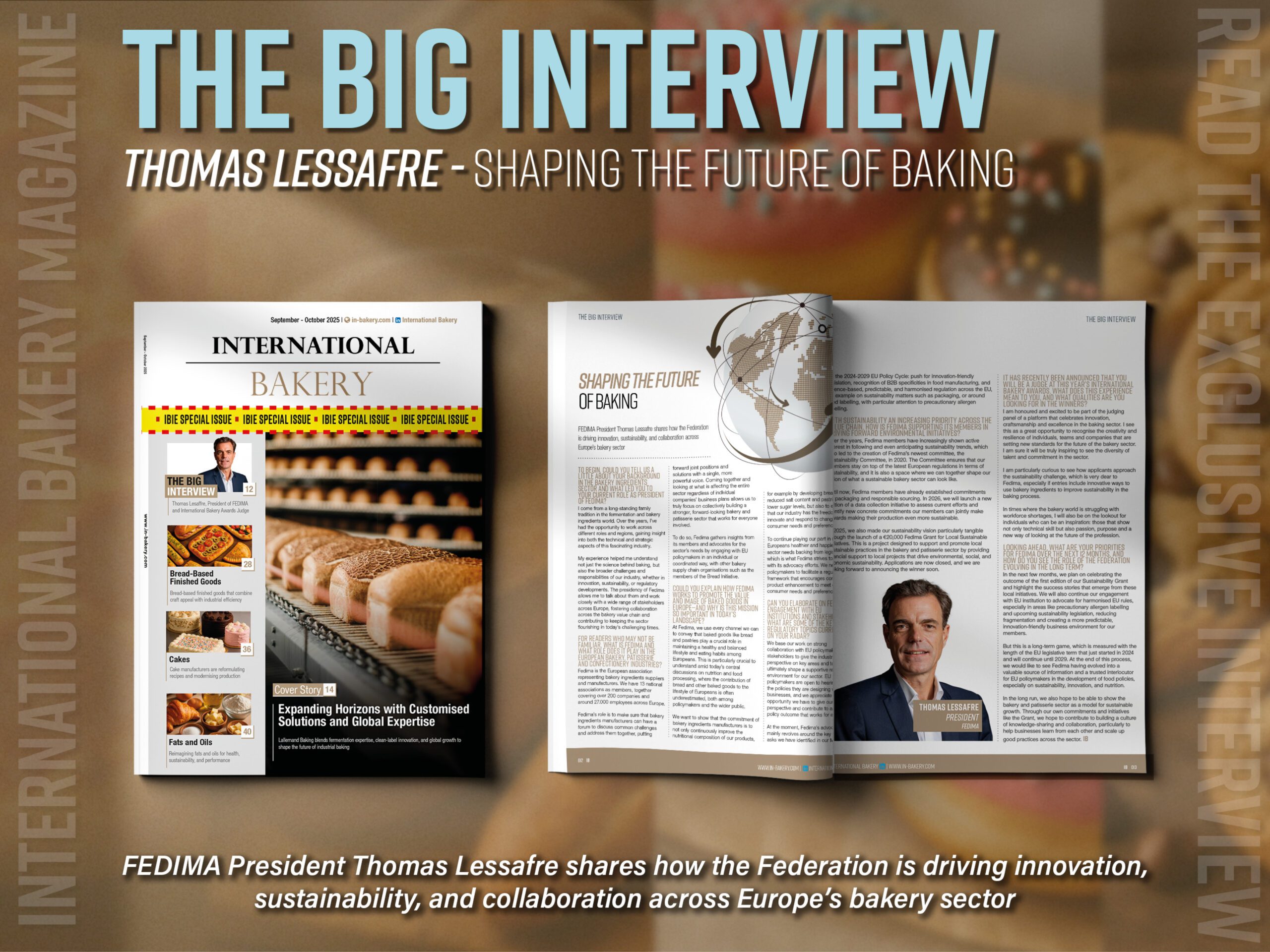

FEDIMA President Thomas Lessafre shares how the Federation is driving innovation, sustainability, and collaboration across Europe’s bakery sector
To begin, could you tell us a little about your background in the bakery ingredients sector and what led you to your current role as President of Fedima?
I come from a long-standing family tradition in the fermentation and bakery ingredients world. Over the years, I’ve had the opportunity to work across different roles and regions, gaining insight into both the technical and strategic aspects of this fascinating industry.
My experience helped me understand not just the science behind baking, but also the broader challenges and responsibilities of our industry, whether in innovation, sustainability, or regulatory developments. The presidency of Fedima allows me to talk about them and work closely with a wide range of stakeholders across Europe, fostering collaboration across the bakery value chain and contributing to keeping the sector flourishing in today’s challenging times.
For readers who may not be familiar, what is Fedima and what role does it play in the European bakery, patisserie and confectionery industries?
Fedima is the European association representing bakery ingredients suppliers and manufacturers. We have 13 national associations as members, together covering over 200 companies and around 27.000 employees across Europe.
Fedima’s role is to make sure that bakery ingredients manufacturers can have a forum to discuss common challenges and address them together, putting forward joint positions and solutions with a single, more powerful voice. Coming together and looking at what is affecting the entire sector regardless of individual companies’ business plans allows us to truly focus on collectively building a stronger, forward-looking bakery and patisserie sector that works for everyone involved.
To do so, Fedima gathers insights from its members and advocates for the sector’s needs by engaging with EU policymakers in an individual or coordinated way, with other bakery supply chain organisations such as the members of the Bread Initiative.
Could you explain how Fedima works to promote the value and image of baked goods in Europe—and why is this mission so important in today’s landscape?
At Fedima, we use every channel we can to convey that baked goods like bread and pastries play a crucial role in maintaining a healthy and balanced lifestyle and eating habits among Europeans. This is particularly crucial to understand amid today’s central discussions on nutrition and food processing, where the contribution of bread and other baked goods to the lifestyle of Europeans is often underestimated, both among policymakers and the wider public.
We want to show that the commitment of bakery ingredients manufacturers is to not only continuously improve the nutritional composition of our products, for example by developing breads with reduced salt content and pastries with lower sugar levels, but also to ensure that our industry has the freedom to innovate and respond to changing consumer needs and preferences.
To continue playing our part in making Europeans healthier and happier, our sector needs backing from legislators, which is what Fedima strives to achieve with its advocacy efforts. We need policymakers to facilitate a regulatory framework that encourages continued product enhancement to meet evolving consumer needs and preferences.
Can you elaborate on Fedima’s engagement with EU institutions and stakeholders? What are some of the key regulatory topics currently on your radar?
We base our work on strong collaboration with EU policymakers and stakeholders to give the industry perspective on key areas and to ultimately shape a supportive regulatory environment for our sector. EU policymakers are open to hearing how the policies they are designing will impact businesses, and we appreciate every opportunity we have to give our sector’s perspective and contribute to a positive policy outcome that works for everyone.
At the moment, Fedima’s advocacy mainly revolves around the key policy asks we have identified in our Manifesto for the 2024-2029 EU Policy Cycle: push for innovation-friendly legislation, recognition of B2B specificities in food manufacturing, and science-based, predictable, and harmonised regulation across the EU, for example on sustainability matters such as packaging, or around food labelling, with particular attention to precautionary allergen labelling.
With sustainability an increasing priority across the value chain, how is Fedima supporting its members in driving forward environmental initiatives?
Over the years, Fedima members have increasingly shown active interest in following and even anticipating sustainability trends, which also led to the creation of Fedima’s newest committee, the Sustainability Committee, in 2020. The Committee ensures that our members stay on top of the latest European regulations in terms of sustainability, and it is also a space where we can together shape our vision of what a sustainable bakery sector can look like.
Until now, Fedima members have already established commitments on packaging and responsible sourcing. In 2026, we will launch a new edition of a data collection initiative to assess current efforts and identify new concrete commitments our members can jointly make towards making their production even more sustainable.
In 2025, we also made our sustainability vision particularly tangible through the launch of a €20,000 Fedima Grant for Local Sustainable Initiatives. This is a project designed to support and promote local sustainable practices in the bakery and patisserie sector by providing financial support to local projects that drive environmental, social, and economic sustainability. Applications are now closed, and we are looking forward to announcing the winner soon.
Read the full interview in our latest issue here