
Senior Editor Joseph Clarke examines how enzymes, yeast and dough conditioners are shaping the future of breadmaking by driving consistency and quality
Industrial breadmaking has always depended on consistency. Whether producing wrapped sandwich loaves, premium artisan-style breads or speciality products at high volumes, manufacturers must deliver the same loaf volume, crumb structure, texture and flavour day after day. Achieving that consistency has never been straightforward, given the natural variation in flour quality, changing environmental conditions and the complexity of large-scale production. Today, however, bakers are balancing an even broader set of priorities.
Consumers increasingly expect breads with cleaner ingredient declarations, reduced salt and extended freshness, while retailers demand longer shelf life and consistent quality across every batch. At the same time, manufacturers are under pressure to improve efficiency, reduce waste, minimise energy consumption and maximise the performance of increasingly automated production lines. Every stage of the process, from mixing and fermentation to baking and packaging, is expected to operate with greater precision than ever before.
Against this backdrop, enzymes, yeast and dough conditioners have become far more than processing aids. They now form integrated ingredient systems that allow bakers to optimise dough performance, improve production robustness and consistently deliver high-quality products despite the many variables that exist within industrial baking. Rather than working independently, these ingredients increasingly complement one another, helping manufacturers adapt formulations to changing raw materials, evolving nutritional requirements and more demanding production environments.
Leading suppliers continue to expand their capabilities in response. Companies such as Lesaffre, AB Mauri and Puratos have developed comprehensive ingredient portfolios combining fermentation expertise with enzyme technologies and dough improvers, while specialists including Corbion, KB Ingredients and Cain Foods provide complementary functional ingredients that support freshness, texture and processing performance. Collectively, these developments reflect an industry that is moving beyond individual ingredients towards complete dough optimisation systems.
How do enzymes, yeast and dough conditioners work together in industrial breadmaking?
Although enzymes, yeast and dough conditioners each perform distinct functions, their greatest value lies in the way they interact throughout the breadmaking process. Successful bread production depends on carefully balancing fermentation, dough strength, machinability and finished product quality, meaning no single ingredient can be considered in isolation.
Yeast remains the engine of breadmaking. During fermentation it converts sugars into carbon dioxide, creating the gas that gives bread its volume while also producing alcohols, organic acids and numerous flavour compounds that contribute to aroma and overall eating quality. Fermentation also influences crust colour by providing sugars that participate in browning reactions during baking. Different production methods require carefully controlled fermentation performance, making yeast selection increasingly tailored to specific applications, production speeds and product types.
Companies such as Lesaffre continue to invest heavily in yeast research, fermentation technologies and technical bakery support, helping manufacturers optimise fermentation across a wide variety of bread formulations and production systems.
Alongside yeast, enzyme technology has become one of the bakery industry’s most important tools for improving consistency. Modern bakery enzyme systems typically combine several enzyme classes, each targeting different components within the dough. Amylases generate fermentable sugars from starch to support yeast activity while also contributing to softer crumbs and longer-lasting freshness. Xylanases improve dough handling by modifying arabinoxylans within flour, enhancing gas retention and loaf volume. Lipases strengthen dough structure and improve crumb characteristics, while other specialist enzymes can further optimise dough tolerance, stability and finished product quality.
The ability to combine multiple enzyme activities allows manufacturers to tailor performance according to specific production requirements. High-speed bread lines, for example, may prioritise dough tolerance and machinability, while premium artisan-style products may place greater emphasis on texture, freshness and eating quality.
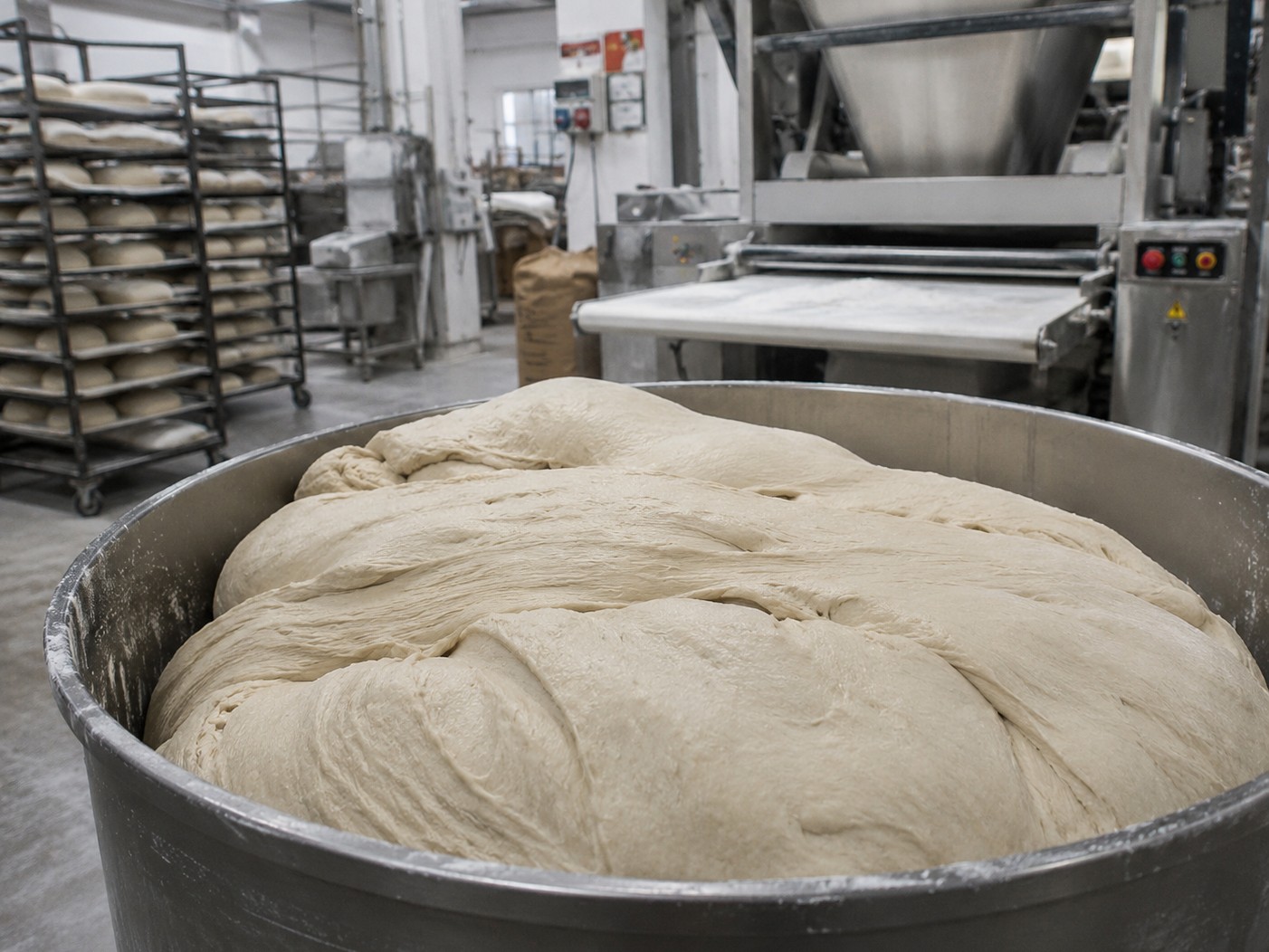
Dough conditioners complete this integrated system by improving dough strength, mixing tolerance and handling characteristics throughout production. Modern industrial bakeries process thousands of dough pieces every hour, placing enormous demands on dough consistency. Variations that might be manageable in a craft bakery can quickly become costly on automated production lines, leading to product waste, downtime or inconsistent quality. Dough conditioners help minimise these risks by improving dough resilience during dividing, moulding, proofing and baking.
Read the full article in our latest issue here