
Helen Xi, Business Development Manager at Intralox, discusses how ProTrax™ is helping bakeries improve pan handling and support more efficient automated production
Intralox describes ProTrax™ as a solution specifically engineered for bakery pan conveyance. What were the key operational challenges in bakery production that led to the development of this technology?
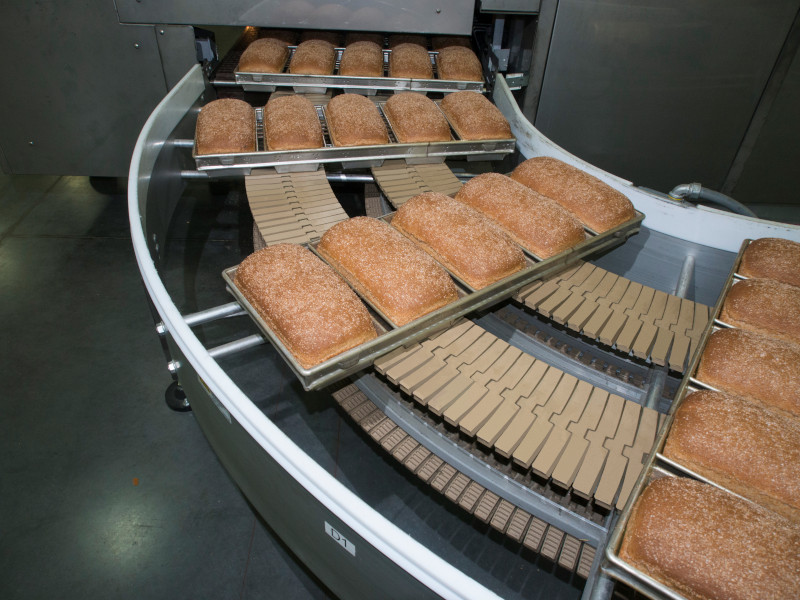
High-volume bakery production environments have traditionally faced significant challenges in reliably conveying pans through increasingly complex processing lines. These systems often include multiple transitions including curves, inclines, declines, and transfers, where maintaining consistent pan control is essential for achieving stable throughput and product quality. As production lines have evolved to handle higher capacities and more automation, these conveying challenges have become more pronounced.
Traditional conveying solutions typically rely on friction or passive guidance, which can limit performance in demanding applications. Common issues include pan misalignment, lateral drift, and instability, particularly when pans are empty or lightly loaded. In these situations, there is not enough weight to stabilise the pan, making it more susceptible to vibration or unintended movement. Over time, these inconsistencies can accumulate, resulting in jams, collisions, or disruptions elsewhere in the line.
Transfer points represent a particularly critical area. Without precise alignment, pans may skew or overlap during transitions, leading to unplanned downtime, product damage, and inefficiencies that ripple across the production process. Even minor disruptions at these points can result in line stoppages, increased labor intervention, and lost productivity.
ProTrax™ was developed to directly address these challenges, delivering improved pan control, greater stability, and more predictable conveying performance in even the most demanding environments.
Traditional pan handling systems can struggle with issues such as mistracking, vibration, and pan instability. How does ProTrax overcome these challenges differently from conventional conveyor technologies?
ProTrax addresses mistracking and vibration by taking a fundamentally different approach to pan control. Conventional systems typically rely on friction-top belts or magnets mounted in the conveyor frame, both of which provide only indirect control of the pan. Friction-based systems depend on surface contact and weight, which can vary significantly depending on pan load, while frame-mounted magnets do not maintain continuous engagement with the pan.
By contrast, ProTrax embeds rare earth magnets directly into the conveyor belt itself, enabling a more direct and consistent interaction with the pan. This innovation transforms the belt from a passive surface into an active control mechanism. As a result, the belt is not just transporting pans but actively stabilizing and guiding them throughout the entire conveying process.
This design allows for stronger and more uniform holding force across the length of the conveyor. Pans remain firmly positioned, reducing the opportunity for lateral movement or vibration. This is particularly beneficial in areas where conventional systems struggle, such as high-speed sections, curves, and transitions.
As a result, pans remain properly aligned and stable throughout the conveying process, even through curves and transfers, significantly reducing mistracking, vibration, and unwanted movement. This improved control leads to smoother line operation, fewer disruptions, and greater overall efficiency.
Could you explain how the magnetic pan handling principle behind ProTrax works, and why it is particularly effective in high-throughput bakery environments?
The ProTrax™ system uses magnetic force to securely hold pans to the surface of the conveyor belt. As pans move through the system, embedded magnets create continuous engagement, keeping them stable and properly aligned during acceleration, curves, inclines, declines, and de-lidding. This continuous magnetic interaction ensures that pans remain in constant contact with the belt, eliminating the variability associated with traditional friction-based systems.
A key advantage of this design is its configurability. The magnetic modules can be arranged based on specific application requirements – for example, magnets can be placed in every row, every other row, or at wider intervals depending on the level of control needed. This flexibility allows manufacturers to fine-tune the system to match the demands of each section of the production line.
For steep inclines or more demanding applications, higher magnet density provides stronger pan retention, preventing slippage or rollback. For less demanding sections, reduced magnet density can be used while still maintaining control, allowing for optimised performance without unnecessary force. This customisation helps balance performance, energy efficiency, and operational needs.
Additionally, this adaptability enables the system to accommodate different pan sizes, shapes, and weights within the same production line. This is particularly valuable in bakeries producing a range of products, as it reduces the need for multiple specialised systems.