

Sandra Lutz, Head of Bühler’s Global Wafer Business Unit, discusses how OptiBake is transforming wafer production with greater efficiency, flexibility and sustainability
Could you begin by giving us a brief introduction to yourself and explain what you do at Bühler?
My name is Sandra Lutz, and I lead Bühler’s global Wafer Business Unit. Wafer sits within our Grains & Food pillar, specifically under the Consumer Foods business area, which has four business units. One of those is wafer, and that is the unit I am responsible for. Globally, we provide a portfolio of equipment and solutions for wafer production—covering flat wafers, waffles, and wafer sticks. It is a very holistic portfolio designed to help our customers successfully produce wafer products of many different kinds.
What trends in consumer behaviour or production expectations influenced Bühler’s decision to pursue inductive heating for wafer ovens?
On the consumer side, sustainability is increasingly important. Although there is no compulsory certification yet for the CO₂ footprint of products, it is easy to imagine this coming in the future, in the same way we have seen regulations for sugar. Consumers are becoming more aware of the sustainability of the products they buy. Another trend is the demand for healthier options, with more functions added into recipes—such as higher levels of protein or fibre. From a recipe perspective, there is a clear move toward improving the healthiness of traditional products, and through our application centres, our specialists and equipment can support those developments.
For our customers—the producers—we also see sustainability playing a role, though legislation varies depending on the region. More consistently, however, there is global pressure to reduce production costs. The biggest lever is efficiency: using less raw material, producing less waste, and still achieving the same output. At the same time, consumer expectations mean manufacturers are pushed to offer more frequent innovations, whether that is different tastes, new product formats, or varied packaging. That increases the need for flexibility in production, with smaller lot sizes, quicker ramp-ups, and greater product variety.
When we began brainstorming what the next big step in wafer baking could be, we talked to customers and market experts to understand what was needed. The answers came back clearly. The next generation of wafer ovens had to address efficiency, flexibility, and sustainability, while at the same time delivering the best wafer sheet quality ever produced, since that directly influences efficiency downstream. From those discussions, the idea for a new oven concept emerged. The result was OptiBake: an oven that uses inductive heating with electricity instead of gas, combined with advanced control systems. This creates an overall package that enables customers to produce more efficiently, more flexibly, and more sustainably—particularly if the electricity is sourced from renewables, in which case production can be achieved with virtually zero CO₂ emissions.
What challenges did your team face when rethinking the conventional wafer baking process, and how did you overcome them with OptiBake’s development?
Electric ovens are not a new idea. One of our key customers reminded us that his grandfather had travelled from southern Italy to Austria decades ago to buy one of the first electric wafer ovens. That was 50 or 60 years ago. But those earlier ovens used conventional resistance heating, which simply is not well suited to wafer production. You cannot control it precisely, you cannot adjust single zones, and you cannot achieve the efficiency and flexibility required today.
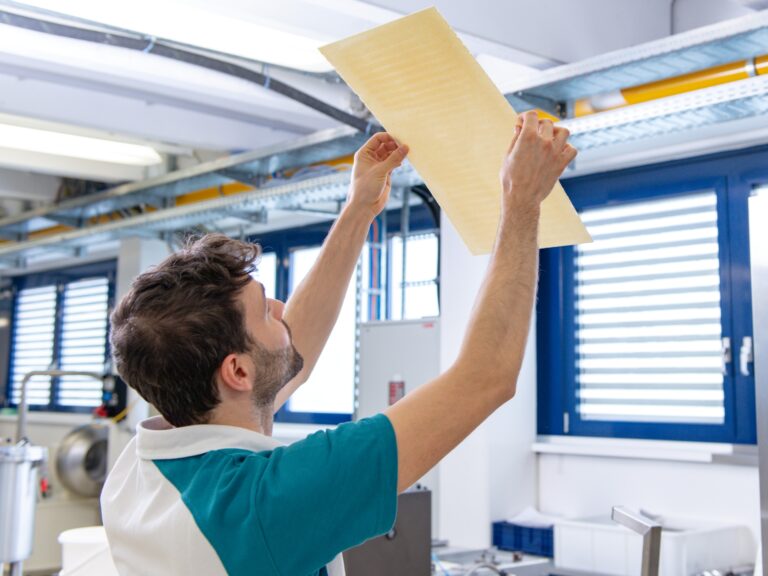
At Bühler we already had experience with inductive heating in wafer stick baking, where we had an oven in our portfolio using this technology. That gave us a strong foundation. The challenge was scaling inductive heating to flat wafer baking. The baking plate is the key component that determines wafer sheet quality, and to make it compatible with inductive heating we had to redesign it. What followed was a development programme with around 20 sub-projects, each addressing different technical challenges, all of which eventually came together in the overall system.
There were three factors that helped us succeed. First was the motivation of our team. When you spoke to the engineers or operators, you could feel their belief in the project. Second was the involvement of customers from an early stage. We had lead customers reviewing our designs, challenging our decisions, and helping us refine the concept. Third was collaboration with academia. For example, part of the control system was developed in partnership with a leading university. The outcome is not simply an oven with inductive heating bolted on. It is a holistic solution: a completely redesigned plate built on mechanical engineering expertise, combined with inductive heating and automation controls, and supported by application technology to produce premium wafer sheets.
As someone leading a business unit dedicated to wafers, how do you balance longstanding traditions in wafer production with the need for innovation?
The fundamental principle of wafer baking has not changed. You still place batter between engraved plates and apply heat. Customers need the reassurance that this principle remains the same, and that the end product they know and trust will not be altered. What changes is how efficiently and flexibly it is produced. That assurance helps customers feel comfortable adopting new technology.
At the same time, we need to demonstrate the value. OptiBake uses 50 per cent less energy per kilo of wafer. In some parts of the world, gas is still much cheaper than electricity, which makes the cost calculation less straightforward. But when you consider all the benefits—reduced energy, increased efficiency, greater flexibility, and improved sustainability—the decision becomes much easier for customers.
With wafers considered a niche within the wider bakery category, could technologies like OptiBake elevate their position in modern bakeries?
I do not think OptiBake will suddenly make wafers more popular, but it does allow our customers to expand their product portfolios. For instance, one oven could potentially operate both flat and hollow wafer engravings at the same time. That means even smaller producers can broaden their offerings without having to invest in separate large-scale equipment. It gives them the flexibility to test and launch new products while still running their core lines.
Read more latest industry news and developments in our free to download magazine.
Never miss a story… Follow us on:
LinkedIn: International Bakery
X: @int_bakery
YouTube: @Bakery-TV
Media contact
Joseph Clarke
Editor, International Bakery
Tel: +44 (0) 1622 823 920
Email: [email protected]