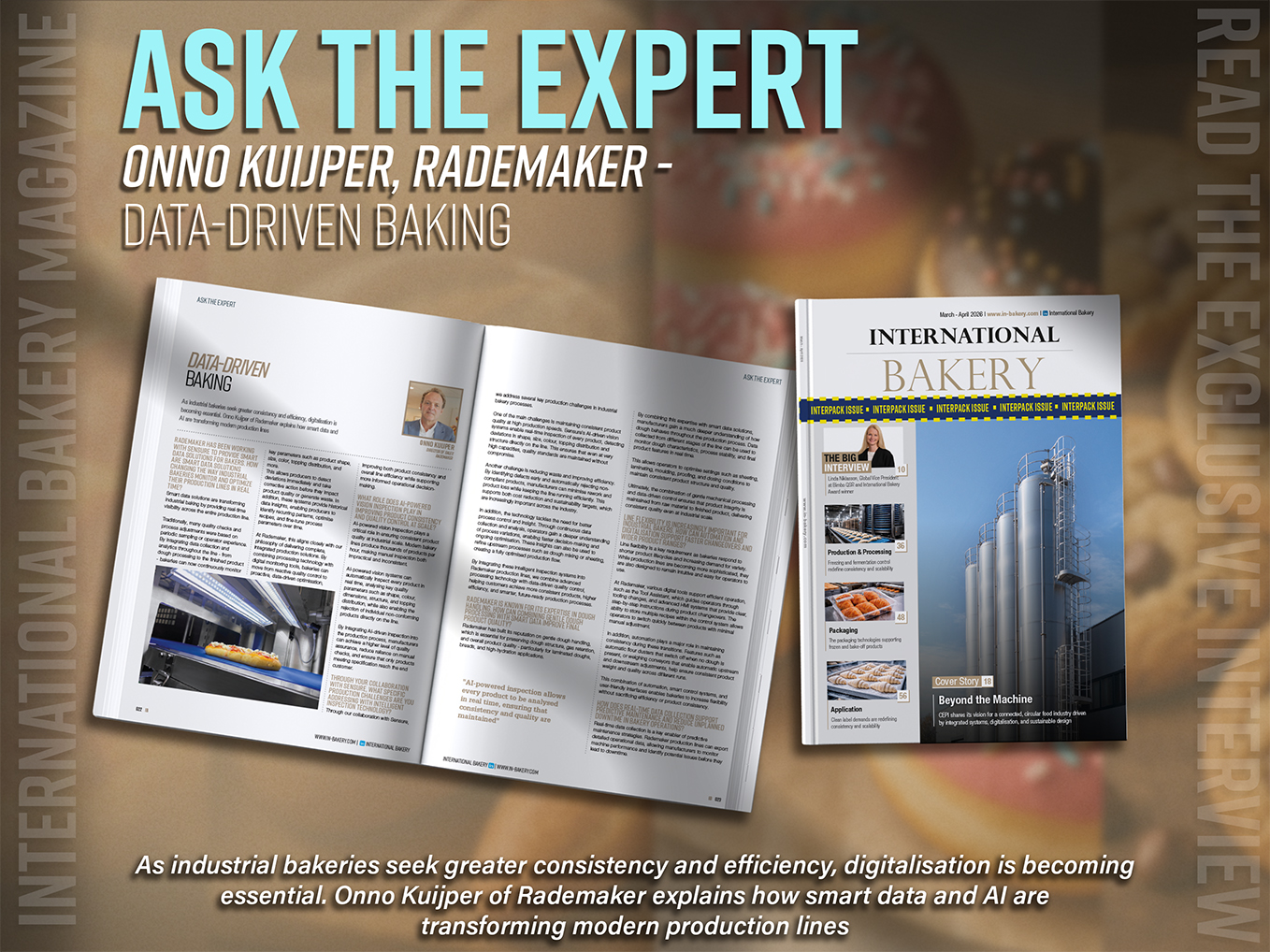

As industrial bakeries seek greater consistency and efficiency, digitalisation is becoming essential. Onno Kuijper of Rademaker explains how smart data and AI are transforming modern production lines
Rademaker has been working with Sensure to provide smart data solutions for bakers. How are smart data solutions changing the way industrial bakeries monitor and optimise their production lines in real time?
Smart data solutions are transforming industrial baking by providing real-time visibility across the entire production line.
Traditionally, many quality checks and process adjustments were based on periodic sampling or operator experience. By integrating data collection and analytics throughout the line – from dough processing to the finished product – bakeries can now continuously monitor key parameters such as product shape, size, colour, topping distribution, and more.
This allows producers to detect deviations immediately and take corrective action before they impact product quality or generate waste. In addition, these systems provide historical data insights, enabling producers to identify recurring patterns, optimise recipes, and fine-tune process parameters over time.
At Rademaker, this aligns closely with our philosophy of delivering complete, integrated production solutions. By combining processing technology with digital monitoring tools, bakeries can move from reactive quality control to proactive, data-driven optimisation, improving both product consistency and overall line efficiency while supporting more informed operational decision-making.
What role does AI-powered vision inspection play in improving product consistency and quality control at scale?
AI-powered vision inspection plays a critical role in ensuring consistent product quality at industrial scale. Modern bakery lines produce thousands of products per hour, making manual inspection both impractical and inconsistent.
AI-based vision systems can automatically inspect every product in real time, analysing key quality parameters such as shape, colour, dimensions, structure, and topping distribution, while also enabling the rejection of individual non-conforming products directly on the line.
Beyond simple defect detection, these systems continuously learn and adapt, improving their accuracy over time and enabling more nuanced quality assessments. This is particularly important for products with natural variation, such as laminated doughs or artisan-style breads, where maintaining consistency while preserving product character is essential.
By integrating AI-driven inspection into the production process, manufacturers can achieve a higher level of quality assurance, reduce reliance on manual checks, and ensure that only products meeting specification reach the end customer.
Through your collaboration with Sensure, what specific production challenges are you addressing with intelligent inspection technology?
Through our collaboration with Sensure, we address several key production challenges in industrial bakery processes.
One of the main challenges is maintaining consistent product quality at high production speeds. Sensure’s AI-driven vision systems enable real-time inspection of every product, detecting deviations in shape, size, colour, topping distribution and structure directly on the line. This ensures that even at very high capacities, quality standards are maintained without compromise.
Another challenge is reducing waste and improving efficiency. By identifying defects early and automatically rejecting non-compliant products, manufacturers can minimise rework and product loss while keeping the line running efficiently. This supports both cost reduction and sustainability targets, which are increasingly important across the industry.
In addition, the technology tackles the need for better process control and insight. Through continuous data collection and analysis, operators gain a deeper understanding of process variations, enabling faster decision-making and ongoing optimisation. These insights can also be used to refine upstream processes such as dough mixing or sheeting, creating a fully optimised production flow.
By integrating these intelligent inspection systems into Rademaker production lines, we combine advanced processing technology with data-driven quality control, helping customers achieve more consistent products, higher efficiency, and smarter, future-ready production processes.
Rademaker is known for its expertise in dough handling. How can combining gentle dough processing with smart data improve final product quality?
Rademaker has built its reputation on gentle dough handling, which is essential for preserving dough structure, gas retention, and overall product quality – particularly for laminated doughs, breads, and high-hydration applications.
By combining this expertise with smart data solutions, manufacturers gain a much deeper understanding of how dough behaves throughout the production process. Data collected from different stages of the line can be used to monitor dough characteristics, process stability, and final product features in real time.
This allows operators to optimise settings such as sheeting, laminating, moulding, proofing, and dosing conditions to maintain consistent product structure and quality. For example, subtle variations in dough temperature or hydration can be detected early and corrected before they impact the final product.
Ultimately, the combination of gentle mechanical processing and data-driven control ensures that product integrity is maintained from raw material to finished product, delivering consistent quality even at industrial scale.